
Market virtualisation and working in dispersed teams are crucial for labour market development
Press release
Published: 20/05/2022
The latest report of the Polish Economic Institute shows that technological (arithmetic mean 5.83) and political (5.48) factors will have the greatest impact on the development of the labour market from now until 2035. Slightly lower scores (5.32) are given to legal factors and economic factors (5.13), while the lowest average scores for the impact of a given group of factors on the labour market in the future are given to ecological factors (4.84), values (5.07) and social factors (5.09), respectively. In contrast, political (3.93) and legal (3.80) factors are among the most difficult to predict. Social factors (3.71) and economic factors (3.70) are considered to be slightly less uncertain in the context of labour market developments up to 2035. The driving forces on the labour market in the outlook to 2035 will be the level of labour market virtualisation and the ability to work in dispersed teams. Based on these factors, four labour market development scenarios and profiles of employees with desirable competences have been formulated and included in the PEI report 'Foresight of Competences of the Future'.
Our study shows that the key factors from the perspective of the future of the labour market are technological, such as the level of digitisation of enterprises, the level of automation of work, the degree of virtualisation of the labour market or the level of development of robotisation in services. An important factor is also the degree of innovativeness of enterprises, which is highly dependent on the aforementioned technological factors. In contrast, the level of labour market virtualisation and the ability to work in dispersed teams are the most uncertain. On the one hand, this may be due to the hope that widespread virtualisation will not be necessary once the pandemic is over, while on the other hand, uncertainty about labour market virtualisation may be due to concerns that not all enterprises will be able to provide sufficient technical support to enable virtualisation. Therefore, the ability to act in a situation of uncertainty is gaining importance, which in turn affects the demand for various cognitive competences, including the ability to find the deeper meaning and sense of phenomena, creative thinking, quick reaction to changes and the ability to analyse and assess risks, says Katarzyna Dębkowska, Head of the Economic Foresight Team at the Polish Economic Institute.
Four labour market development scenarios
Based on the identified factors, four labour market development scenarios have been proposed.
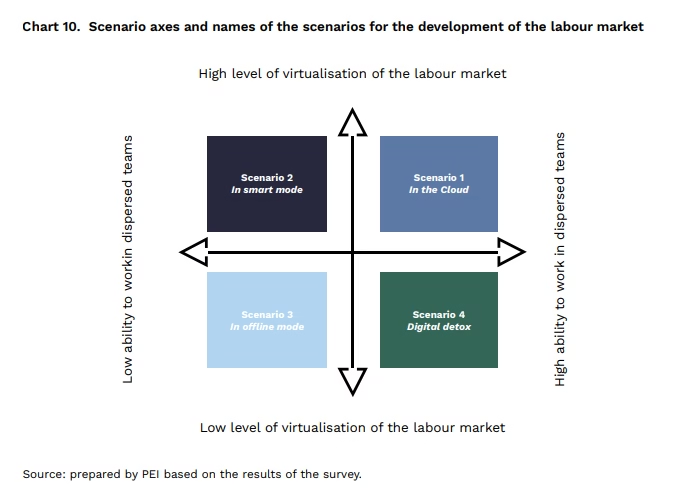
The ‘In the Cloud’ scenario assumes a high level of labour market virtualisation and a high capacity for dispersed teams. In this case, virtual technologies will contribute to increased job mobility and almost unlimited access to data in time and space. In this scenario, the key skills will prove to be advanced digital competences, transformative competences, the ability to act in situations of uncertainty and social competences such as creativity and teamwork.
The ‘Smart’ scenario assumes a high level of labour market virtualisation and a low ability to work in dispersed teams. By combining the competences of humans and machines, the labour market model will move towards a hybrid one, and working with advanced machines and algorithmic systems will require primarily technical and digital competences, but also the capacity for systems thinking, creativity and collaboration skills.
In the ‘Offline’ scenario, we would see a low level of labour market virtualisation and a low ability to work in dispersed teams. This would be associated with a decline in job mobility, lower innovation and limited cooperation with foreign organisations. This would translate into a return to traditional forms of work, which would require industry-specific specialist competences, the ability to take responsibility for one’s own actions, competences in using pro-environmental and pro-social solutions, as well as the ability to find oneself in situations of uncertainty and social competences related to the ability to work in desk-based teams.
In contrast, the ‘In digital detox’ scenario assumes a low level of labour market virtualisation and a high level of skills for working in dispersed teams. This scenario implies several negative consequences for the labour market. The return to the analogue world means that competence gaps emerge due to the need for employees with high digital skills to adapt to working in an analogue environment, while specialist competences and the ability to work in desk-based and dispersed teams become more important. Work-life balance is also increasingly important.
Political and legal factors increase the feeling of uncertainty
When analysing the arithmetic averages of the uncertainty of each group of factors obtained, it can be seen that the most uncertain factors to be predicted are in the political (3.93) and legal (3.80) ones. The social (3.71) and economic (3.70) factors were considered to be slightly less uncertain in the context of the development of the labour market by 2035. In contrast, the factors that are considered to be the easiest to predict and the most certain were value-related (3.55), environmental (3.47) and technological (3.34) ones.
***
The Polish Economic Institute is a public economic think tank dating back to 1928. Its research primarily spans macroeconomics, energy and climate, foreign trade, economic foresight, the digital economy and behavioural economics. The Institute provides reports, analyses, and recommendations for key areas of the economy and social life in Poland, taking into account the international situation.
Media contact:
Ewa Balicka-Sawiak
Rzecznik Prasowy
M: +48 727 427 918
E: ewa.balicka@pie.net.pl
