
Poland’s path to prosperity – GDP per capita in Poland has grown by 266% over the past 35 years
Press release
Published: 20/10/2026
Poland's radical economic opening to the West in 1990 marked the beginning of the country's path to prosperity. Compared with other economies in the region, Poland stood out for the two-way liberalisation of trade, capital flows and access to the services market. Today, it is one of the wealthiest countries in the region. Cumulative GDP per capita growth in 1990-2025 reached 266%, bringing a dramatic improvement in living standards. The employment rate rose to its highest level on record, above the EU average. Among people aged 20-64, it increased from 65% in 1998 to 79% in 2025. The share of people with tertiary education more than tripled. High-tech goods increased from 2.3% of total goods exports in 2002 to 11.2% in 2025. At the same time, Poland's economic model is characterised by the absence of excessive state intervention. In the PMR index, which measures market distortions and barriers to expansion, Poland performs better than more than 76% of OECD countries. These are the main conclusions of the Polish Economic Institute report “Four Decades of Success: Poland's Path to Prosperity”.
Productivity growth has driven the strongest increase in real GDP in the region
Although the whole of Central and Eastern Europe is a contemporary example of a successful economic transformation, Poland remains the regional leader both as the largest economy and in terms of the fastest rate of economic growth. Poland’s economy is now more than 250% larger than it was in 1990. GDP per capita has increased by 266%. This reflects an increase in labour supply, but above all, productivity growth.
“The average Pole is now wealthier than around 85% of the world’s population. In the 1990s, our GDP ranged between 20% and 40% of the level recorded in countries regarded as wealthy. Today it is as high as 75-100%. GDP per capita at purchasing power parity has virtually caught up with Japan, while approaching the EU average and South Korea. Since the start of the transformation, Poland has overtaken one in nine countries in the world in terms of prosperity,” says Marcin Klucznik, Senior Advisor in the World Economy Team at the Polish Economic Institute.
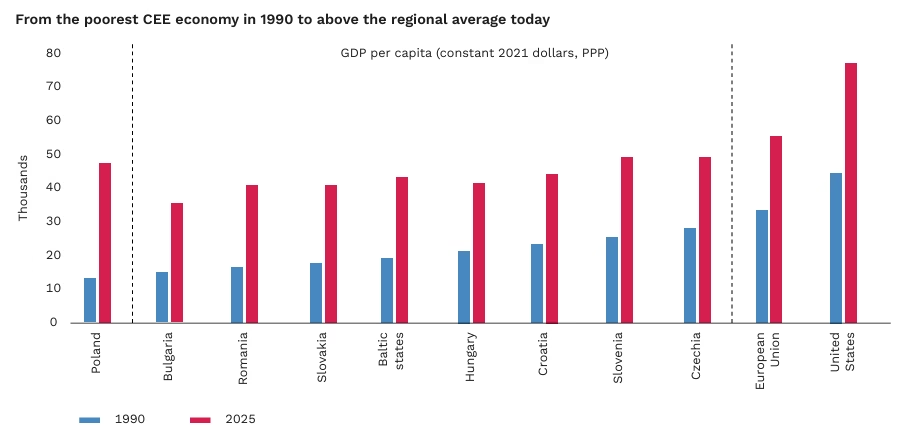
Real convergence is accompanied by nominal convergence, meaning that wages and prices are becoming more similar. In Poland, real GDP per capita has risen to 81% of the EU average, while prices remain 27% lower. A similar process occurred in other countries in the region, although Poland’s experience was unusual in that nominal convergence stalled between 2008 and 2021. This reversed from 2022 onwards, leading to a significant appreciation of the real exchange rate of the zloty and, with it, higher wages and greater purchasing power for Poles abroad.
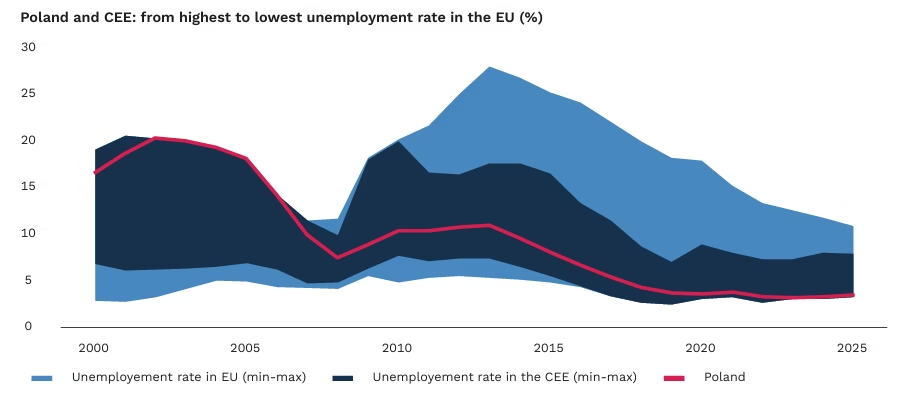
Labour-market transformation: from the highest to the lowest unemployment in the EU
Although the shock economic changes of the early 1990s resulted in high unemployment, Poland’s employment rate is now at an all-time high. Among people aged 20-64, it rose from 65% in 1998 to 79% in 2025. Currently, 91% of men and 83% of women aged 25-54 are employed in Poland. In the 55-64 age group, the employment rate increased by two-thirds for men and doubled for women.
It should be noted that, compared with other EU countries, Poles enter the labour market at a relatively late age and retire relatively early. As a result, the share of employed people in the total population remains below the EU average despite the above-average employment rate among people aged 20-64 and a population that is younger than the EU average. Further improvements in labour productivity remain an important source of Poland’s potential economic growth.
Strong human-capital potential
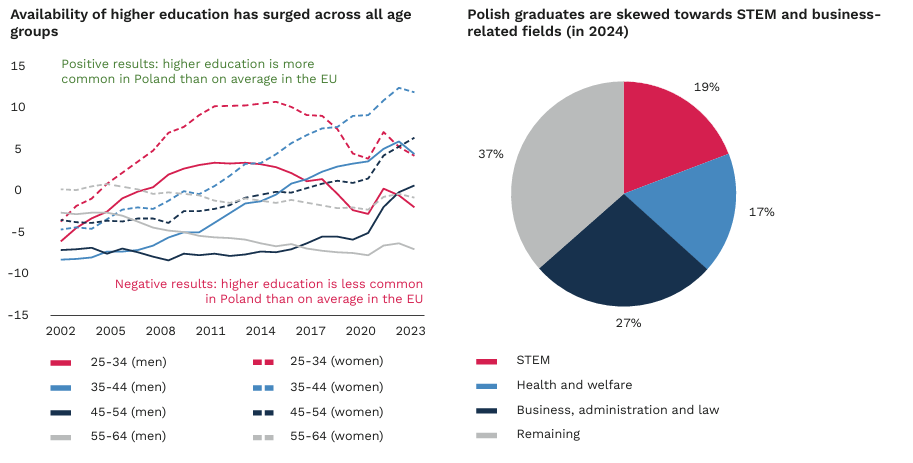
Poland and the region as a whole are characterised by a high level of human capital. Over the past four decades, tertiary education has become widespread in Poland. In 1998, only 9% of Poles aged 15-74 had a tertiary education; today the figure is 32%. It is even higher among younger age groups: 45% among people aged 25-34 and 51% among those aged 35-44. Polish science has also developed over the past 30 years. Although the scale of R&D expenditure in Poland is lower than in developed countries, mainly because Poland is at a different stage of development, R&D intensity has increased 2.5-fold over the past 30 years, from 0.6% of GDP in 1996 to 1.4% in 2024. The number of researchers has risen in a similar way, from 0.14% to 0.37% of the population.
“In PISA tests, Polish students perform better than those in most developed economies. In most age and gender groups, Poles are better educated than the European average. Sixty per cent of women aged 35-44 have a tertiary education, more than 12 percentage points above the EU average. Although Polish universities are relatively small and rather rarely function as modern research institutions, their geographical dispersion and size help them fulfil their educational role: there are around 18,000 people of student age per university. Poland could become a research hub for the whole of Central and Eastern Europe. Of every EUR 1 spent on research in the region, as much as EUR 0.42 is spent in Poland. Poland also has the fourth-largest number of scientists and engineers in the EU, at 1.7 million. That is more than 30% more than in Italy or the Netherlands,” says Marcin Klucznik.
Foreign investment and the development of international trade have driven Poland’s economic growth
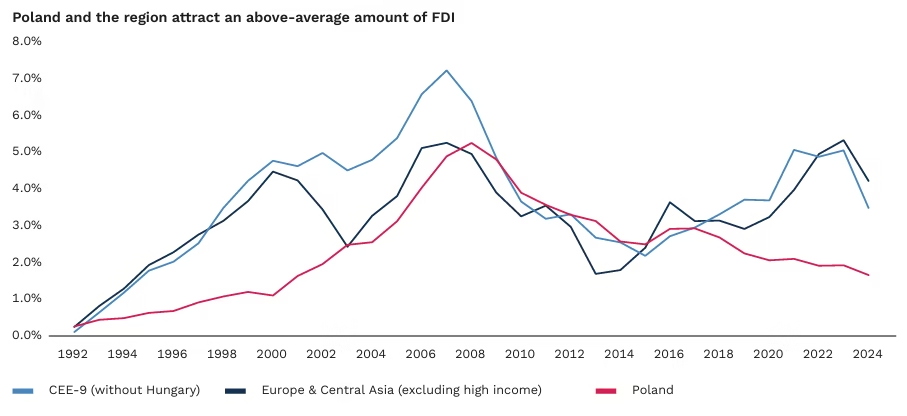
The inflow of foreign direct investment into Poland and the rest of the region has been a lasting driver of economic growth through economic integration, comparative advantages, and the transfer of technology and skills. On average, Poland attracted foreign investment equivalent to around 3.5% of GDP each year. The region’s economic attractiveness is shaped by a combination of skilled, relatively lower-cost workers and the stability resulting from EU membership. More than half of FDI inflows into Poland consist of reinvested earnings. As much as 76% of FDI flowing into Poland in 2004-2025 took the form of equity investment: 25% was new capital and 51% was reinvested earnings. These measures point to both the profitability and the attractiveness of the region as a whole.
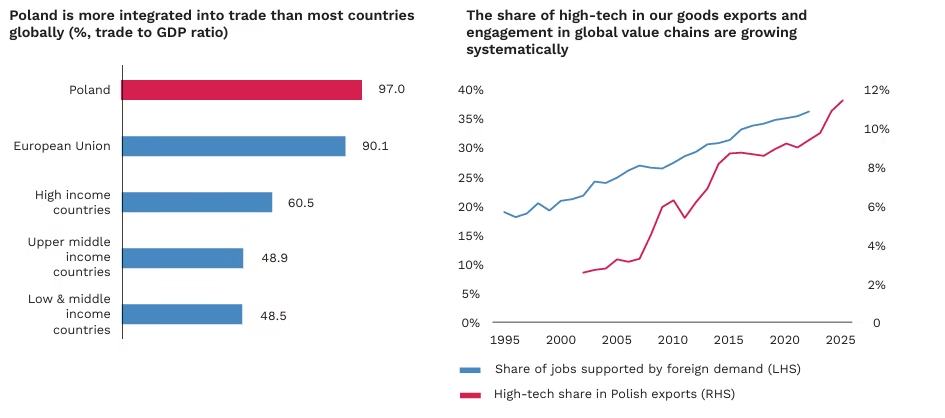
One of the best illustrations of Poland’s economic transformation from a centrally planned economy in the Eastern Bloc into a modern state connected with the whole world is the development of international trade. In 2025, the total value of Poland’s trade flows reached 97% of GDP, more than the average in the EU or among developed economies. Today, one in three jobs in Poland is linked to foreign demand. The share of high-tech goods in total goods exports rose from just 2.3% in 2002 to 11.2% in 2025.
Activities characteristic of the wealthiest economies are gradually appearing in Poland’s services exports. The best example is exports of R&D services, which increased from PLN 1.7 billion in 2010 to PLN 14.5 billion in 2025. The share of R&D in services exports rose from 1.6% to 3.0%. The region as a whole has created an additional industrial hub in Europe. Thirty years ago, Central and Eastern Europe accounted for just 5.1% of the manufacturing value added generated in the EU-27, less than any of the individual large Western European economies, such as France (15.8%), Italy (15.2%) or Spain (6.7%). Today, the manufacturing sector of Central and Eastern Europe as a whole is smaller only than Germany’s. Productivity in Polish manufacturing has increased by more than 281% over 30 years. Two of the three ‘locomotives’ of Polish industry are more technologically advanced sectors. Since 1995, value added in the production of electrical equipment has increased by 1,841%, while in electronics and computers it has risen by 948%.
Development of modern services
Service industries are modern activities with the greatest impact on Poland’s economic growth. Some are directly based on FDI inflows, while others are rooted in local education and domestic entrepreneurship. The combined share of service sectors in Poland’s value added rose from 55.3% in 1995 to 68.2% in 2024. Employment in services increased by 53%, from 7.2 million to 11.1 million people. These sectors have been responsible for the increase in the employment rate and for absorbing the growing labour-force participation of Poles. One of Poland’s major successes has been the rapid growth of employment in high-paying services, including professional, scientific and technical activities, as well as IT. Employment in these sectors has increased more than fourfold, and they now employ more than 1.5 million people.
Economic success at a demographic cost
Alongside economic growth, the population of Poland and the region as a whole has been shrinking relative to the EU. Between 1995 and 2024, the population of Central and Eastern Europe fell by 9.8 million, to 100 million. Over the same period, the population of the remaining EU countries increased by 34.0 million. Until 2015, Poland consistently recorded a negative net migration balance. Economic success helped reverse this trend by encouraging returns to the country. The number of temporary departures also began to decline gradually. The number of Poles living abroad increased until around 2018-2019 and then began to fall. Low fertility remains the fundamental challenge. The decline in fertility in Poland has been one of the steepest in the developing world. Even if negative fertility trends were to begin reversing, a substantial population decline would still be unavoidable over the next few decades because of the smaller number of people of reproductive age.
***
The Polish Economic Institute is a public economic think tank with a history dating back to 1928. Its main research areas include macroeconomics, energy, the global economy, economic foresight, digital economy, sustainable development, and behavioral economics. The Institute prepares reports, analyses, and policy recommendations on key areas of the Polish economy and society, taking into account the international context.
Media Contact:
Ewa Balicka-Sawiak
Press Officer
T: +48 727 427 918
E: ewa.balicka@pie.net.pl
