
Economic Weekly 41/2026, October, 16, 2026
Published: 16/10/2026
Table of contents
The decline in Polish investment abroad in 2025 was mainly driven by intra-group financial transactions
USD 2.4 billion the decrease in the net balance of loans and other financial transactions between companies within corporate groups (known as debt instruments) in 2025
24% the increase in Polish investment abroad excluding debt instruments in 2025
USD 1.6 billion Polish equity investment in foreign companies in 2025
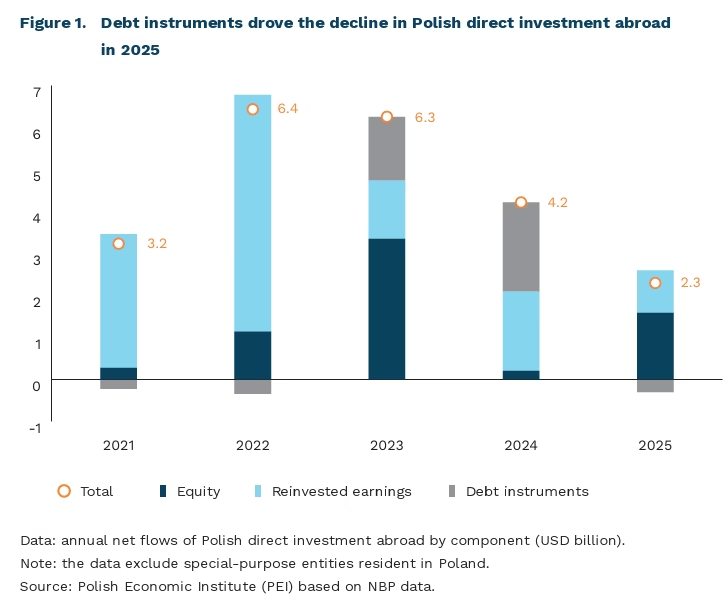
In 2025, Polish direct investment abroad amounted to USD 2.3 billion, according to NBP data, compared with USD 4.2 billion a year earlier, a decline of 45.5%. Such a sharp decline may suggest that Polish companies are scaling back their operations abroad. However, changes in intra-group financing, including loans and deferred payments for supplies, had the greatest impact on the result. The net balance of these transactions fell from USD 2.1 billion to -USD 0.3 billion. The overall result was also affected by a decline in reinvested earnings (of USD 0.9 billion), meaning profits retained in foreign companies. At the same time, the value of equity transactions, including acquisitions and capital injections, increased by USD 1.4 billion.
The change in intra-group financial transactions had two causes. First, Polish parent companies provided less financing to their subsidiaries. After accounting for repayments and other settlements, this financing amounted to USD 0.5 billion, compared with USD 2.1 billion a year earlier. The largest negative net balances were recorded in transactions with entities in Norway and Lithuania (a combined USD 0.8 billion). Second, foreign companies extended loans to their parent companies or purchased bonds issued by them. The net balance of these transactions amounted to USD 0.8 billion, compared with almost zero a year earlier. In Lithuania, the negative net balance of debt transactions was accompanied by USD 0.4 billion in equity investment. This may partly reflect the conversion of debt owed to ORLEN into equity, as described in ORLEN Lietuva’s report.
Excluding debt instruments, capital outflows associated with Polish investment abroad increased from USD 2.1 billion in 2024 to USD 2.6 billion in 2025, or by 24%. This amount comprised equity transactions, including acquisitions and capital injections (USD 1.6 billion), and reinvested earnings (USD 1.0 billion). The value of the former was the second highest in 2021-2025, with Türkiye, Lithuania, Czechia and Germany accounting for approximately 81% of their total net balance. Reinvested earnings, meanwhile, were lower than a year earlier, falling from USD 1.9 billion to USD 1.0 billion, largely because of losses incurred by companies with Polish equity operating in Czechia.
The decline in Polish direct investment abroad therefore does not, in itself, mean that companies are either withdrawing from foreign markets or reducing their activity there. Even excluding debt instruments, however, a simple comparison with 2021-2023 may be misleading because it masks the specific circumstances of that period. The high figures in 2021-2022 were mainly attributable to reinvested earnings and the commodity boom (profits were concentrated in mining and quarrying and, geographically, in Norway), while the high figure in 2023 reflected substantial equity transactions concentrated primarily in retail trade and a few countries (Czechia, Romania, Slovakia and Spain). Given the still limited scale of Polish investment, a few corporate groups or activity in a single industry can determine the result for an entire year. Assessing whether Polish companies’ foreign expansion is accelerating or slowing therefore requires observation over a longer period and an analysis of individual companies’ behaviour and financial decisions.
Dominik Kopiński
Business pessimism does not reflect GDP trends
39% of firms expect the economic situation in Poland to worsen in the last quarter of 2026
over 60% of firms cite economic uncertainty as a barrier that severely hampers their business
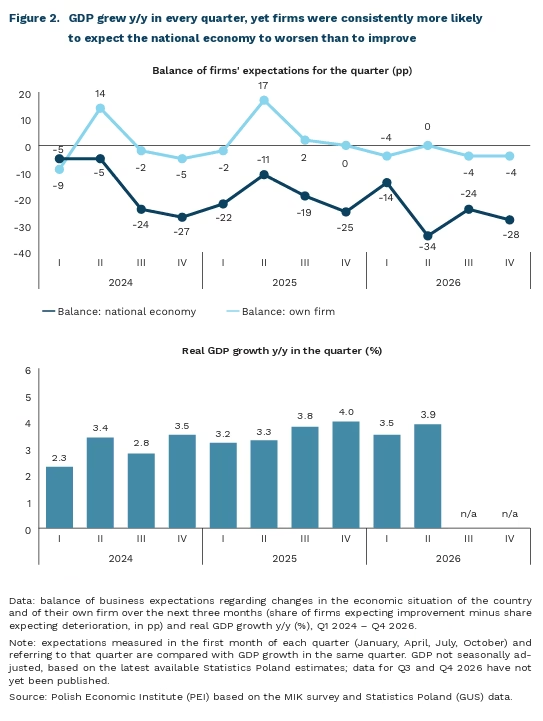
In April 2026, 46% of firms surveyed for the Monthly Business Sentiment Index (MIK) expected Poland’s economic situation to deteriorate in the second quarter, while only 12% expected it to improve. Yet in that quarter Poland’s GDP grew by 3.9% y/y, faster than in the first quarter, and gross fixed capital formation rose by 8.4% y/y. This gap between business expectations and macroeconomic data has persisted for years and is not unique to Poland. Pessimism about the country’s economic situation does not stem from the condition of firms themselves – they assess their own prospects considerably better – but from perceived economic uncertainty. For years, businesses have been more likely to expect the national economy to worsen than to improve. In each of the twelve quarterly MIK surveys since January 2024, the share of firms expecting a deterioration over the next three months exceeded the share expecting an improvement, with the difference (balance) ranging from 5 to 34 percentage points. Over the same period, economic growth accelerated: after near-zero growth in 2023 (0.1%), GDP rose by 3.0% in 2024 and 3.6% in 2025. Even if “deterioration” is understood as a slowdown in growth, expectations do not match the data: GDP growth slowed in only three of nine quarters, and the deepest pessimism (-34 pp in Q2 2026) was recorded during a period of acceleration.
Firms’ pessimism about the national economy does not stem from the condition of the firms themselves. Their outlook for their own business is far more balanced: in 2026 the shares of firms expecting improvement and deterioration were almost equal (balance between -4 pp and 0 pp), and more than half of firms expected no change.
October MIK microdata show that pessimism about the national economy (39% of firms expect it to worsen in the last quarter of 2026) is only partly driven by firms’ own results. Even among firms whose sales increased, 31% expect the national economy to deteriorate, while 19% expect it to improve. Uncertainty about doing business is more strongly associated with how firms assess the national economy: among firms for which it is a significant barrier, 48% expect the Polish economy to worsen, compared with 26% among the others. This suggests that businesses judge “the state of the country” primarily through labour and energy costs and the predictability of regulation, rather than through GDP growth.
A similar gap can be observed in other countries. In the US CFO Survey, optimism about respondents’ own firms stood at 70.7 points out of 100 in Q2 2026, compared with only 60.6 points for the US economy. In Deloitte’s CFO Signals survey for the same quarter, four in ten chief financial officers rated the economy as bad, while nine in ten were optimistic about their own company. In the euro area, the ECB noted that at the end of 2025 the manufacturing PMI fell below 50 points, even as hard data on industrial production pointed to growth. Business surveys regularly paint a gloomier picture than macroeconomic statistics. In the literature, this phenomenon is known as the optimism gap: people rate their own prospects considerably better than those of their country. This also applies to firms. Research based on data from the German ifo Institute shows that companies react strongly to information about themselves but only weakly to information about the economy as a whole – the authors called this the “island illusion”.
Business pessimism about the national economy does not foreshadow changes in GDP; rather, it reflects perceived economic uncertainty. It is not irrelevant, however: when uncertainty is high, firms postpone decisions on investment and hiring, which over the longer term may weaken the economy’s growth potential, even if this is not visible in current data. For public policy, this means that communicating good data alone will not lift sentiment. Reducing the sources of uncertainty may be more effective – genuine consultation on legislation, adequate vacatio legis periods, and less frequent changes to taxes and social security contributions – which, at little cost to the budget, could improve the investment climate.
Katarzyna Dębkowska
There are too few economically inactive people to fill labour shortages
455 thousand the number of economically inactive working-age people who wanted to work in 2025
887.9 thousand the number of registered unemployed in December 2025
2.1 million PEI’s estimated fall in the number of people working in Poland by 2035
According to the OECD, encouraging economically inactive people to join the labour market has become a priority for its member countries, as demographic changes are reducing the labour supply. Including those who are neither working nor seeking employment in the labour market can help to mitigate worker shortages, reduce spending on benefits, and reduce inequality.
In Poland, the shrinking number of potential workers is particularly noticeable. Between 2012 and 2022, the working-age population fell by 2.4 million, and PEI predicts a further drop of 2.1 million by 2035.
The decline in labour supply can be partially addressed by engaging the unemployed or the economically inactive, but these resources are clearly limited. In December 2025, only 887.9 thousand people were registered as unemployed with labour offices. The economically inactive working-age population is much larger (around 3.7 million), but considerably harder to bring into the labour market. Labour market institutions are beginning to recognise the need to engage with this group too: from June 2025 onwards, the new Act on the Labour Market and Employment Services will require labour offices to engage with economically inactive individuals as well as the unemployed.
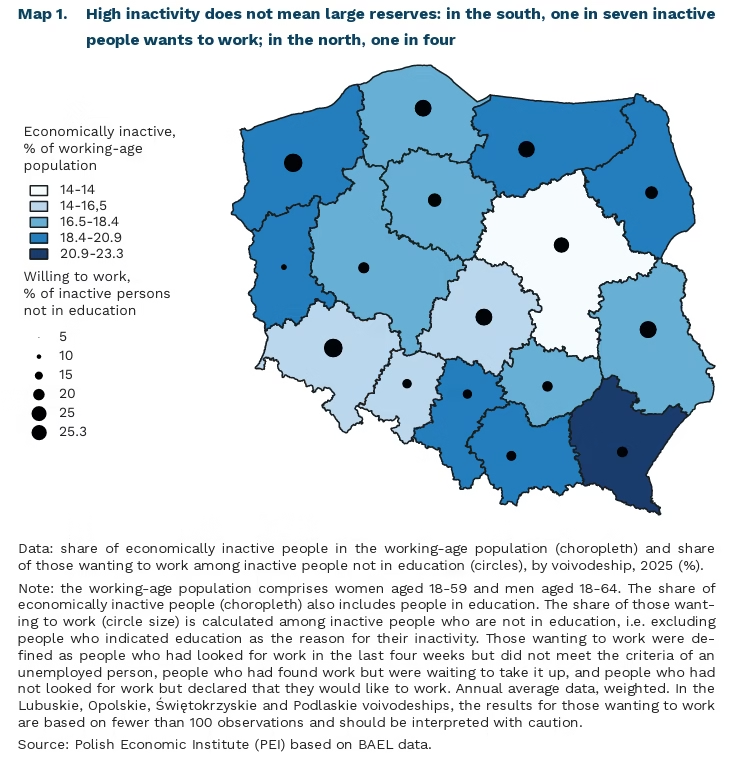
PEI estimates suggest that the potential for activating this group is, however, limited. Of the approximately 2.6 million economically inactive working-age individuals not in education, around 455 thousand stated in 2025 that they wished to work. This is equivalent to one in six inactive individuals (calculations based on BAEL data). This figure is similar to the OECD’s estimate for 2024 (approximately 460,000).
This does not mean that all of these people can start work immediately. Around half of those who want to work are not actively seeking employment due to health issues, disabilities, or care responsibilities. A further 20% cite family circumstances or personal reasons. Around 40% of men say they are unable to work due to illness or disability, and 27% have an official disability certificate. Among women, more than a third say they have care responsibilities, and around 30% have a child under five at home. Within this group, 36% of women and almost one in four men have been out of the labour market for at least five years, while 16% and 12% respectively have never worked.
According to the OECD, Poland’s economic inactivity rate is slightly lower than the OECD average, but there are significant regional disparities. New BAEL data confirms this. In 2025, 23% of the working-age population in Podkarpackie were inactive, compared to around 21% in Małopolska, 20% in Silesia and only 14% in Mazovia. High inactivity does not necessarily mean large labour reserves. In the three southern voivodeships, only one in seven or eight inactive people not in education wants to work. In the voivodeships of Warmińsko-Mazurskie and Zachodniopomorskie, where inactivity is similarly high, the figure is one in four or five.
These data show that, with labour resources shrinking rapidly, activation measures alone may not be enough. At the same time, productivity growth is becoming more important. Research by Daron Acemoglu and Pascual Restrepo shows that, in countries with a rapidly ageing population, automation can mitigate the effects of demographic change. While it will not automatically replace missing workers, it makes a strong case for combining activation measures with those that raise the economy’s productivity.
Agata Mróz
The presence of technology-related terms in a company’s description does not necessarily indicate that it is innovative
The share of startups with at least one reference to technology in their business description rose from 12.2% in 2013 to 47% in 2025 (Dealroom database)
approximately 6% of startups show signs of potentially developing their own technologies
An analysis of 6,289 startups shows that only some of the companies explicitly name the technologies they use [1]. In the database, exact matches for terms from the technology glossary were found for approximately 18% of the sample group. For the remaining startups, no exact match for a phrase from the glossary was found. However, this does not necessarily mean a lack of technology-related activity companies may describe their activities using different words or offer solutions not included in the glossary.
AI and automation are among the most frequently mentioned technology terms. The term „artificial intelligence” was mentioned 659 times, „automation” 413 times, and „machine learning” 311 times. Other terms included „generative AI” (103 matches), „computer vision” (84), and „deep learning” (62). The results show that AI appears in company descriptions in various contexts from content generation and machine learning to image recognition and process automation.
Technology is increasingly prominent in the descriptions of newer startups, but this does not necessarily indicate a proportional increase in innovation. The share of companies with at least one exact match to the glossary rose from 12.2% in 2013 to 34.3% in 2023-2024 and 47% in 2025. In the partial year of 2026, it stood at 51.7%. This increase may stem both from a greater presence of technology and from changes in how companies describe their activities or in the completeness of the data. Additionally, a preliminary analysis indicates that only a portion of the companies show signs that they may be developing or offering their own technological solutions. A heuristic analysis of the descriptions revealed that only some startups show signs of potential technological development (approximately 6% of the entire database) or strong integration of existing solutions (approximately 3.5%) [2] The remaining cases are more ambiguous, and references to technology in the descriptions do not always allow for a clear determination of its role. These companies may use off-the-shelf (third-party) tools, implement solutions from other vendors, or merely mention technology for marketing purposes. However, based on the available data, it is not possible to determine which of these situations apply. The mere presence of technological terms therefore does not determine either a company’s innovativeness or whether it creates its own technology or develops existing technology.
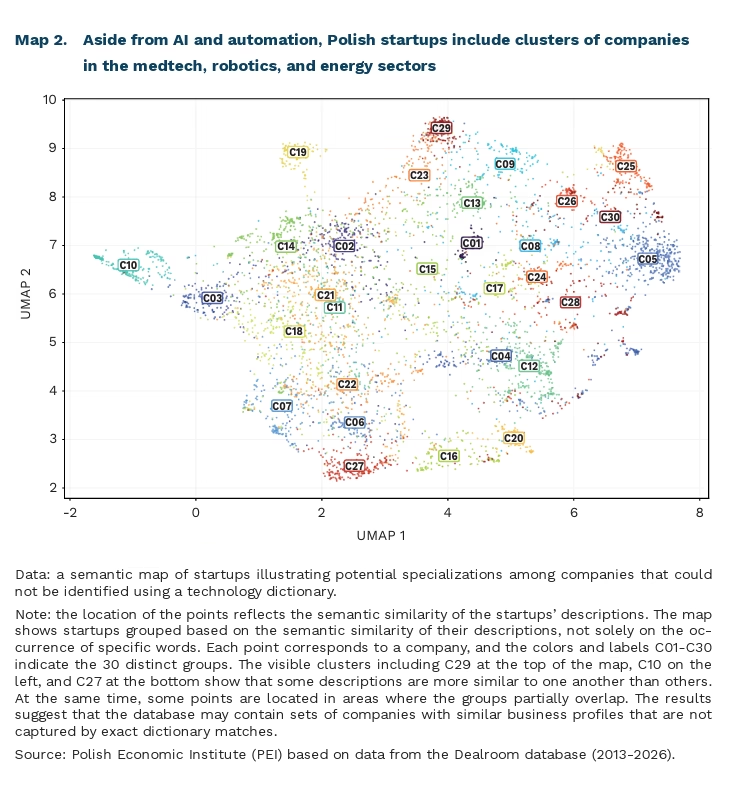
AI and automation are the most prominent terms in the technology lexicon, but semantic analysis also points to other areas of activity among Polish startups. The semantic model used to analyze startups without requiring an exact lexical match identified 30 thematic groups (shown in the figure). Notably, there are clearly distinct clusters of companies operating in the fields of medical technology (C16 in the figure), advanced materials and additive manufacturing (C17), software and digital infrastructure (C29), fintech – B2C (C10), fintech and SaaS software – B2B (C03), and video games (C19) [3]. The other clusters analyzed are more diverse and include energy production (including renewable energy), enterprise software and SaaS, and food production.
The technology lexicon used and the additional clusters identified may point to potential areas of specialization for Polish startups. The tools developed allow not only for the identification of specializations that go beyond the technology glossary itself (and are therefore potentially more forward-looking or innovative), but also for assessing whether the companies under study are actually developing new technologies or using existing tools (e.g., as integrators). In either case, this can translate into economic opportunities – the benefits of new technologies will be felt both when they are developed and when they are adopted, leading to increased productivity.
- The study utilized thematic modeling tools, a glossary of technology terms, and Dealroom’s database of Polish startups from 2013 to 2026. The glossary was compiled based on: JRC’s “Weak Signals in Science and Technologies,” 2024 (the report identified 221 early technology signals divided into 12 thematic groups), as well as JRC’s “EU in the Global Artificial Intelligence Landscape,” IDEAS “Retaining the Best” – trends in artificial intelligence education at the doctoral level, and ASPI’s Critical Technology Tracker. The glossary is used to identify early trends in technological development. The JRC refers to these as “weak signals,” i.e., early signs of development that may indicate the emergence of new technologies. The glossary serves as a reference point for analyzing data from the Dealroom database.
- The results obtained are indicative and should be treated as evidence rather than definitive confirmation of the nature of the company’s business.
- The two analysis methods complement each other: the dictionary identifies companies that use specific terms, while the semantic model allows us to detect semantic similarities in descriptions, even when companies use different vocabulary.
Magdalena Lesiak
The AI boom is boosting trade and investment first, with productivity gains coming later
4.5% this is the projected economic growth rate in East Asia and the Pacific in 2026, driven in part by exports of AI-related high-tech goods
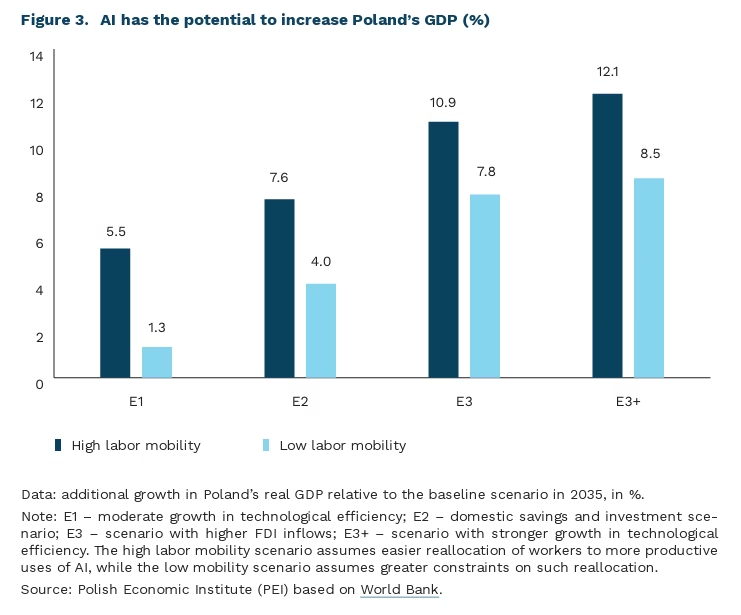
12.1% this is how much AI could increase Poland’s real GDP by 2035 under a high-productivity- growth scenario, compared with 1.3% under a low-productivity- growth scenario
AI is having an increasingly noticeable impact on the global economy, but its initial effects are primarily evident in investment and trade, rather than in productivity. The IMF notes that the global economy remains resilient despite the new energy shock, thanks in part to AI-related investments. Demand for high-tech goods related to AI – such as processors, memory chips, servers, and cooling systems-significantly boosts the performance of economies participating in technology supply chains. Currently, trade in such equipment accounts for nearly half of the growth in global merchandise trade. The Asia region is projected to grow by 4.5% in 2026, and growth forecasts have been raised for Malaysia, Thailand, and Vietnam, among others. The AI boom thus acts primarily as a demand stimulus for industry, exports, data centers, energy, and digital infrastructure.
Europe is benefiting from the boom, but to a lesser extent than Asia and the U.S. The ECB cites this in its September projections as one of the reasons for moderate growth: Eurozone GDP is projected to grow by 0.9% in 2026, 1.4% in 2027, and 1.5% in 2028. Foreign demand for the eurozone has been revised upward, but the growth is concentrated in AI-related goods, in which the eurozone has a limited share. European exports include, among other things, semiconductor manufacturing equipment, telecommunications and networking equipment, and data center infrastructure components. AI can therefore support the European economy primarily through investments that increase trade, though the scale of this impact will be limited.
For Central Europe, the development of AI means both changes in the labor market and new investment opportunities. The World Bank notes that about one-fifth of workers in the developing economies of Europe and Central Asia are in occupations significantly exposed to the impact of AI, but less than 10% of companies use this technology in their operations. This means that the automation of certain tasks may alter the labor market landscape, although the benefits of higher productivity remain limited for now. However, the region can also benefit from the AI boom through the construction of data centers. Poland manufactures products belonging to 102 of the 164 product groups needed for such investments; however, these are primarily low-tech equipment. Domestic companies involved in this supply chain can therefore benefit from growing demand.
For Poland, the extent of the benefits from AI development will depend largely on the pace at which AI solutions are implemented in the economy. The World Bank estimates that AI could increase Poland’s real GDP by 1.3% by 2035 under a conservative scenario of low labor mobility, and by 12.1% under a scenario of labor mobility and stronger growth in technological efficiency. The magnitude of the effect depends on the pace of corporate investment, employee adaptation, and capital inflows. However, the expansion of data centers alone will not ensure sustained productivity growth for domestic firms, which can utilize AI regardless of the infrastructure’s location. Therefore, the long-term benefits for Poland will depend not only on the size of technological investments but, above all, on the ability of enterprises to leverage AI in their operations.
Sebastian Sajnóg
Economics Nobel awarded for research on macroeconomic stability
The 2026 Sveriges Riksbank Prize in Economic Sciences in Memory of Alfred Nobel has been awarded to Robert Hall and Michael Woodford. Both are authors of research examining the question of macroeconomic stability. Hall’s work helps explain the macroeconomic significance of the relationship between economic agents’ rational expectations about the future and their impact on consumption. It has also shed light on how imperfect competition and labor market dynamics drive business cycle fluctuations. Woodford’s work has advanced our understanding of macroeconomic relationships that have proved particularly important for the conduct of central banks, especially in their fight against inflation.
Hall produced some of his major works in the 1970s, a period of economic downturn, the oil crises and stagflation. It was also a time when the dominance of traditional Keynesianism in economics and economic policy was collapsing, and no one was able to say how to get out of the crisis of the day. Economists began to doubt whether economic policy tools could effectively manage the business cycle at all. This stemmed in part from unclear microfoundations, that is, the difficulty of understanding how the macroeconomy is linked to the decisions of individual firms and households. It is precisely these microfoundations that the laureates developed. Woodford is one of the leading architects of the microfoundations of the New Keynesian macroeconomic model, a school of thought that became one way of overcoming some of the shortcomings of traditional Keynesianism. The shared achievement of both laureates was to show that the economy can be actively and effectively stabilized by economic policy that takes into account the role expectations play in shaping the business cycle.
In his 1978 paper, Hall showed how important rational expectations about the future are in shaping consumer decisions. According to his framework, people plan their consumption based on how they expect their income to evolve over their entire lifetime (although he was neither the only nor the first author of this theory). On theoretical grounds, he presented a macroeconomically compelling picture of a consumer who plans their spending carefully, taking into account all the information available to them when forming expectations about the future. The outcome of this process forms the basis for the consumer’s consumption decisions. This means that a rational person bases their consumption decisions not only on their own circumstances, such as an expected change in income, but also on the likely effects of a given economic policy. They adjust their consumption to anticipated changes in taxes, interest rates or inflation. As a result, current changes in income lead to only limited changes in consumption. Larger swings in consumption, in turn, are unpredictable, because they stem from genuinely new information or events. This places a limit on the effectiveness of traditional economic policy. The paper was recognized mainly for its methodological contribution, as Hall proposed algebraic techniques that are now considered standard in macroeconomic models.
Hall also approached macroeconomic stability from the perspective of business cycle theory. He showed that business cycle fluctuations stem in part from the existence of monopolists, and that an economic upturn does not necessarily result from higher productivity of workers themselves, but rather from the presence of firms with market power to set prices higher and that have previously unused production capacity at their disposal.
Hall also highlighted the role of wage rigidity in the business cycle. When the economy weakens, workers’ bargaining position deteriorates, and they should be willing to accept lower wages if they want to keep their jobs, so unemployment need not rise sharply. However, Hall (including in his work with Milgrom) argued that firms are aware that wages are rigid, so during a downturn they tend to cut back on hiring, unwilling to risk the cost of searching for workers who match their needs. As a result, there are fewer job openings on the market, and unemployment rises more than alternative theories predict. The Hall–Milgrom model incorporating wage rigidity is now a well-established concept in labor market macroeconomics.
Expectations also matter in Woodford’s work, though here they relate to the actions of the central bank. In his framework, changes in interest rates do not work solely through changes in the cost of credit. What matters is the interest rate that consumers and firms expect in the future. For example, if a central bank raises rates today but signals a quick return to low levels, the economy may respond differently than when the central bank convinces market participants that tight policy will be maintained for an extended period. This is because decisions such as buying a home or investing in a factory depend on financing costs over the entire horizon (and therefore on expectations of future interest rates). Moreover, if the central bank responds to inflation too weakly, people’s expectations of future inflation do not shift strongly enough, and the policy is ineffective.
Woodford also developed the fiscal theory of the price level. According to this theory, governments in poor fiscal shape that are unable to repay their obligations will not declare bankruptcy to shed their debts, but will instead choose to inflate them away, which is also what other economic agents expect. In this theory, the answer to the threat of inflation is therefore fiscal discipline rather than monetary policy.
In policy practice, this body of work gave prominence to forward guidance, a central bank tool that involves officially communicating the future path of policy. Woodford’s work also helped make the case for inflation targeting as the main guiding principle of central bank policy, a framework adopted by one central bank after another since the late 20th century, including the National Bank of Poland (NBP). Although the effectiveness of forward guidance is sometimes called into question today, it remains a widely used tool.
The work of Woodford and Hall has made a significant contribution to developing tools for understanding, modeling and shaping economic policy aimed at maintaining economic stability. As representatives of a very “traditional” approach, they could certainly have been recognized earlier. Today, expectations are seen as an important factor not only in macroeconomics but also more broadly in sociology, psychology, and even in research on fertility decisions or in narrative economics, a field that has been developing over the past few years. The rational expectations tradition, however, faces criticism from many different perspectives [4]. Today it is hard to accept the assumption, which is not easy to defend empirically, that the world is so predictable and comprehensible that people can genuinely form rational forecasts and base their decisions on them, especially decisions with significant, long-lasting consequences. Critics also point to the problem of fundamental uncertainty (which Keynes himself raised long ago), as well as to cognitive biases that limit the rationality of expectations (a key critical insight of behavioral economics and economic psychology). This does not necessarily undermine the laureates’ achievements, but it does highlight how much social sciences have advanced.
4. In one of his papers, Woodford himself demonstrates the possibilities of macroeconomic analysis without assuming that economic agents have rational expectations.
