
Economic Weekly 43/2026, October, 30, 2026
Published: 30/10/2026
Table of contents
102nd World Savings Day
On October 31, the financial world will mark the 102nd World Savings Day. The date commemorates the conclusion of the First International Savings Bank Congress, held in Milan in 1924. During the congress, representatives of banks from 27 countries (including delegates representing Polish savings banks) initiated annual educational initiatives highlighting the importance of saving for the long-term development and stability of societies. To mark the occasion, the PIE Economic Weekly devotes special attention to data and analyses on the level of savings held by Polish households, as well as to the tools and mechanisms that make saving easier – and those that make it more difficult.
In his article, Jędrzej Lubasiński analyzes Eurostat data showing that Polish households have the third-lowest savings rates in the European Union, after Greece and Romania. At the same time, Poles rank among the EU leaders in terms of the share of cash in their accumulated assets. However, they most commonly hold their savings in the form of current account deposits. Both forms of savings are characterized by easy access, which, as the author suggests, may explain why the proportion of people in Poland who expect to have difficulty covering an unexpected expense is relatively low compared with the EU average.
Piotr Kamiński examines the potential for changing the structure of Poles’ savings through a new savings and investment mechanism that has been announced for several months and is expected to become available early next year: Personal Investment Accounts (Osobiste Konta Inwestycyjne, OKI). The main advantage of this instrument is that the assets held in these accounts are exempt from capital gains tax, an incentive that has proved fairly effective in encouraging some savers in Japan, Sweden, and the United Kingdom. The author expects that this solution may encourage some people to become more actively involved in the capital market. However, he emphasizes that the widespread adoption of OKI will depend on their flexibility, ease of use, and effective financial education.
Iga Rozbicka and Marta Seredyńska analyze Poles’ engagement in long-term saving, paying particular attention to the growing popularity of the Employee Capital Plans (Pracownicze Plany Kapitałowe, PPK) program. The sharp increase in the number of participants following the 2023 re-enrolment cycle demonstrates the effectiveness of a solution inspired by behavioral economics, in which participation in the program is the default option, with the possibility of opting out. However, the authors identify two important areas in which the program’s potential remains untapped. The first is the significantly lower participation rate among employees of smaller companies. The second is the withdrawal of funds before the age of 60, which reduces the assets accumulated to support individuals during periods of reduced or discontinued professional activity.
Finally, in his article on the growing popularity of buy-now-pay-later (BNPL) services, particularly among younger consumers, Jakub Witczak highlights the ambiguous role of this relatively new financial tool in shaping saving habits. On the one hand, it can serve as a kind of safety net, helping people preserve their existing savings and maintain liquidity in the event of unexpected expenses. On the other hand, it may tempt consumers to take on excessive financial commitments and create a risk of losing control over their spending. Encouragingly, the data indicate a high degree of financial discipline among BNPL users: most repay their obligations within the interest-free period.
The analyses presented in these articles show that effective saving is not merely a matter of individual habits, preferences, and discipline, but also depends on the design of institutional arrangements that can help foster financial prudence and awareness of the need to save. Societies that have developed these habits and internalized this knowledge more effectively are often regarded as having a strong culture of saving. Historical circumstances, however, have also played a role, as the resources and institutions available to these societies have helped support such behavior. In Poland, limited financial resources are increasingly ceasing to be a barrier to saving, while institutions are providing ever more professional support. Nevertheless, a third element is needed for success: trust in programs offered by the state. It can be expected that sustained and stable growth in the assets accumulated through these programs will, in turn, help build this trust.
Agnieszka Wincewicz-Price
Polish households save money consistently, but not much
the savings rate in Poland was 9.5% in the first quarter of 2026
cash held by Polish households amounted to 11.5% of GDP in the first quarter of 2026
Polish households have one of the lowest savings rates in the entire European Union. In the first quarter of 2026, the share of savings in disposable income was only 9.5%. This is the third-lowest figure after Greece and Romania, where this ratio was below 0%. By comparison, in other countries in our region, such as the Czech Republic and Hungary, the savings rate exceeded 19%, while the EU-wide average was 14%. At the same time, the savings rate in Poland has been steadily rising – in 2025 and 2024, it exceeded 9%. These are the highest figures in years, with the exception of 2020. Between 2010 and 2019, the savings rate in Poland averaged 7%.
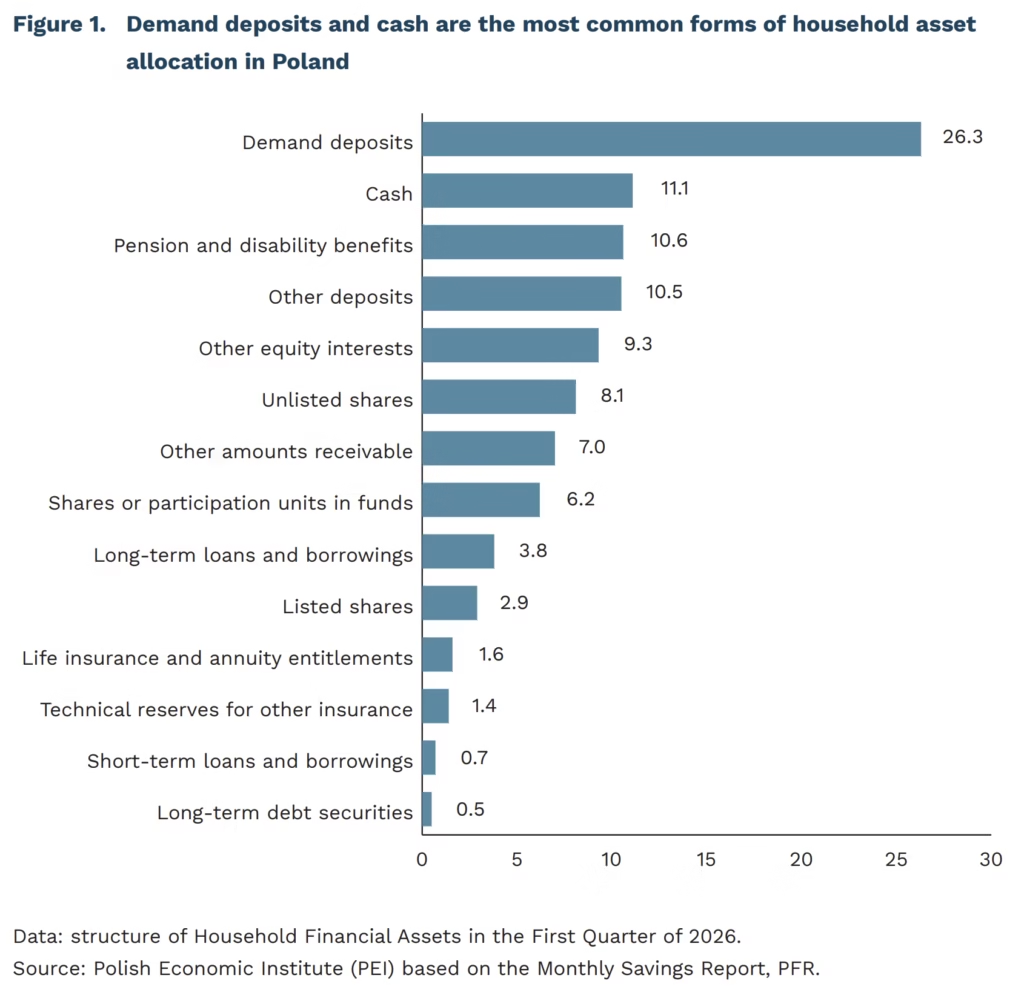
In the first quarter of 2026, the financial assets of Polish households reached 104.6% of GDP. However, this figure is largely made up of demand deposits and cash. In the first quarter of 2026, these two categories together accounted for 37% of the asset structure. Current transaction deposits accounted for 26%, while cash accounted for 11%. Poland stands out from other countries in terms of the value of the latter category. At the beginning of this year, the value of cash held by Polish households amounted to 11.5% of the country’s GDP, which ranks third in the EU behind Slovenia and Germany, with the EU average standing at 4.7%. In terms of demand deposits, Poland ranked roughly in the middle – in 16th place – with a figure of 27% of GDP, compared to the EU average of 32% of GDP.
These results – in terms of disposable income that can easily be spent on consumption – correspond to a relatively good performance regarding the ability to cope with unexpected financial expenses. According to Eurostat data, approximately 22% of households in Poland indicated that they would not be able to cope with such an expense.1 This is the 8th lowest percentage in the EU, with the average standing at 29%. These data can therefore be interpreted as an indication that Poles save more for a “rainy day” than for the more distant future. In this regard, when broken down by household size, single-parent households with one child fare the worst. In this case, 49% of such households reported difficulties in coping with unexpected expenses. At the other end of the spectrum were families with one or two children. Here, the percentage of households that would be unable to cope with an unexpected major expense was only 17% and 15%, respectively.
The rise in the savings rate among Polish households will create opportunities for the growth of asset classes other than cash and checking accounts. Once they have built up a safety cushion for a rainy day, households will find it easier to allocate additional funds to investments geared toward a longer-term horizon, such as investment funds or stocks. Signs of this can currently be seen in the year-over-year increase in the value of investment fund shares2 by 31.5%. However, this category still accounts for only 6.2% of the structure of financial assets held by households in Poland. The shift toward other forms of saving may be facilitated by the PPK, IKE, and IKZE programs, and, starting in 2027, also by the OKI. The value of assets in the first of these programs alone increased by 43.4% year-over-year in September 2026, reaching PLN 58.7 billion.
1 Eurostat lists, among other things, the costs of surgery, a funeral, a replacement of washing machine or a car as unexpected financial expenses. 2 Shares or units in investment funds other than money market funds. This item includes shares in investment funds (open-end, mixed, or closed-end), trust funds, or other collective investment schemes other than money market funds.
2 Shares or units in investment funds other than money market funds. This item includes shares in investment funds (open-end, mixed, or closed-end), trust funds, or other collective investment schemes other than money market funds.
Jędrzej Lubasiński
Personal Investment Accounts (OKI) could reshape the structure of Poles’ savings
47.9% the share of cash and deposits in the financial assets of Polish households at the end of Q1 2026
6.2% the share of investment fund units in Poles’ financial assets, compared with the EU average of 16.4%
approx. PLN 74 billion the additional capital that could flow into the Warsaw Stock Exchange (WSE) by 2040 following the introduction of OKI, according to estimates by the Ministry of Finance
Personal Investment Accounts (OKI) will be introduced in Poland at the beginning of next year, aiming to encourage households to invest in the capital market. The need for such solutions stems, among other factors, from the structure of Poles’ savings, as discussed in the previous article. According to PFR data, at the end of Q1 2026, cash and overnight bank deposits accounted for just over 37% of households’ financial assets, while other deposits (including term deposits) represented a further 10%. At the same time, directly held listed shares accounted for only 2.9%, and investment fund units for 6.2%. Both figures were significantly below the respective EU averages of 8.2% and 16.4%. This points to considerable potential for increasing the share of household savings invested in the capital market, thereby strengthening its role in financing business development. The Ministry of Finance estimates that OKI could generate approximately PLN 74 billion in additional capital inflows to the WSE by 2040. Similar schemes are already in place in many other countries.
International experience suggests that tax incentives can help encourage wider participation in investing. One example of a scheme similar to Poland’s OKI is Japan’s NISA programme, which allows individuals to invest in shares and investment funds, among other instruments, without paying capital gains tax. In 2024, the programme was expanded by increasing investment limits and introducing an indefinite tax exemption. The number of investment accounts reached 30.5 million in June 2026, an increase of 8.1% compared with the end of 2025. Similar ISK accounts are also highly popular in Sweden, where more than 4.2 million people held assets in such accounts in 2025. Meanwhile, in the United Kingdom, contributions were made to 16.8 million ISA accounts during the 2024/2025 tax year. Nevertheless, a significant proportion of British households continue to prefer safer forms of saving, supported by the availability of Cash ISAs. Total assets held across all ISA accounts reached GBP 952 billion.
The simplicity and flexibility of the available schemes also matter. A comparison of schemes operating in Sweden, the United Kingdom, France and Italy indicates that wider adoption is primarily supported by straightforward tax rules, flexible withdrawal options and a broad range of eligible financial instruments. At the same time, the UK example illustrates that a significant proportion of ISA accounts are deposit-based (Cash ISAs), allowing individuals to hold savings in interest-bearing bank accounts without paying tax on interest, rather than investing directly in the capital market. Consequently, the popularity of such schemes does not necessarily translate into a proportional increase in equity investment. In Italy, meanwhile, only 1.5% of adults used the more restrictive PIR accounts, which require investments to be held for at least five years and funds to be allocated primarily to the domestic market.
The impact of OKI on the Polish economy will depend on the level of participation in the programme. Tax incentives may encourage households to increase their involvement in the capital market, including individuals who have not previously used investment instruments. At the same time, redirecting some savings from deposits towards the equity market could increase stock market liquidity and improve companies’ access to financing. However, financial education will also play a crucial role in promoting these forms of saving by raising awareness of available investment opportunities and the risks associated with them.
Piotr Kamiński
More and more people are saving through Employee Capital Plans (PPK)
4.52 million PPK participants (as at 30 September 2026)
63% of those eligible to participate in PPK have active accounts (participation rate; as at 30 September 2026)
Despite concerns about financial security in retirement, few Poles save with this stage of life in mind. According to the Eurobarometer, in 2023 only 20% of Poles believed that, once they reached retirement age, they would have sufficient means for a decent standard of living. A September 2026 survey by VeloBank, in turn, shows that one in four Poles has no savings at all, and that only 28% of those who save are putting money aside for retirement. Saving for a rainy day remains the most common goal, cited by 53% of respondents.
Employee Capital Plans (PPK) are one response to the low propensity to save for retirement. They draw on now-classic behavioural public policy tools used around the world, such as the default option and the re-enrolment mechanism.
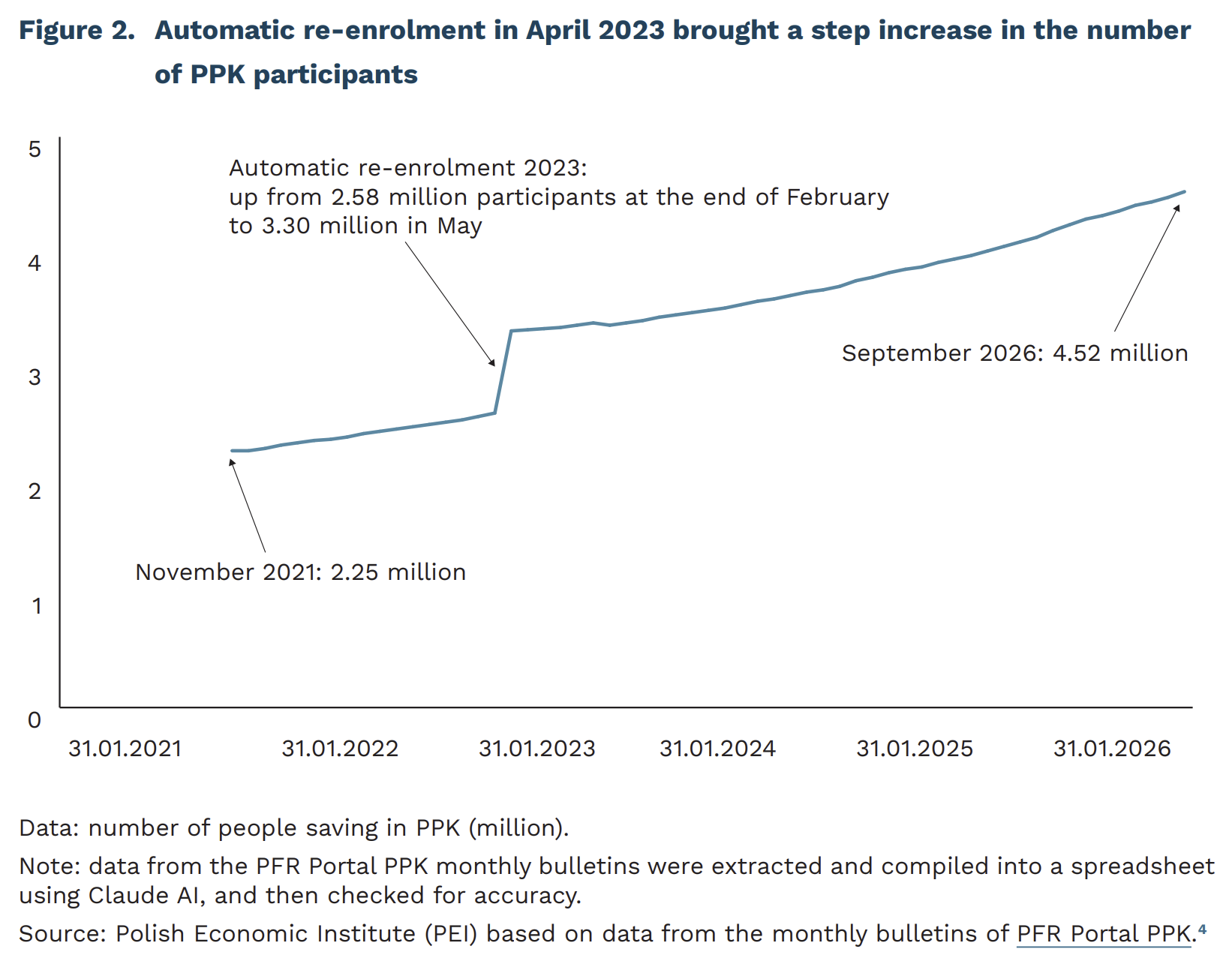
The number of PPK participants keeps growing. Automatic re-enrolment in April 2023 brought a step increase in participation. The number of savers rose from 2.58 million at the end of February 2023 to 3.30 million in early May 2023. At the end of September this year, 4.52 million Poles were saving through the programme and the participation rate stood at 63%. 3 The number of PPK savers rose by 53,000 over the month and by 0.52 million over the year.
The net asset value of target-date funds is also rising. At the end of September 2026 it stood at PLN 58.7bn – PLN 0.91bn more than a month earlier and 44% more than a year earlier (PLN 40.82bn).
The smallest firms are less likely to implement PPK. The participation rate was 92% in firms employing more than 1,000 people, 69% in those employing 250-999, 42% in those employing 50-249 and 34% in those employing 10-49. In the smallest firms it was 75%, but this figure should be interpreted with caution: the rate covers only employers with an active PPK management agreement and at least one active account. Meanwhile, Ministry of Finance (MF) estimates show that in 2025 35% of employers had concluded such an agreement.5 Among those employing fewer than 10 people, the share was just 16%. By comparison, it was 80% among firms with 10-49 employees and highest among firms with 50-249 employees, at 95%. Not having an agreement is not in itself a breach of the law. Exemptions from this obligation apply, among others, to micro-enterprises in which all eligible employees opt out.
Some PPK participants choose to withdraw their savings before retirement, although the scale of this is limited. According to PFR Portal PPK, in Q1 2026 withdrawals amounted to less than 5% of the number of participants, and half of those who have ever made a withdrawal (56%) did so only once. Early withdrawal is not optimal from the perspective of long-term saving: it limits the potential gains from compound interest and entails additional financial consequences.6
The PPK programme supports the accumulation of long-term household savings, but its design alone is not enough to overcome all the barriers that limit its reach. The propensity to save for the long term may be influenced, for example, by beliefs about the state’s role in providing financial security in old age, or by trust in financial institutions. Although the official participation rate already exceeds 60%, it does not fully reflect how widely PPK has been taken up by employees, particularly in the smallest firms. Poles’ low propensity to save (discussed in an earlier article) also remains a significant problem. For some employees, regular contributions may be (or may seem) difficult to reconcile with day-to-day expenses, and a lack of other savings may prompt participants to withdraw money from PPK early. Despite these limitations, the steady growth in the number of participants nevertheless points to the programme’s success. The automatic re-enrolment scheduled for 2027 is likely to bring another step increase.
3 Note: the participation rate is an official statistic published by PFR Portal PPK. When interpreting the data, it should be borne in mind that it is the ratio of the number of active PPK accounts to the number of people employed by employers that have an active PPK management agreement and at least one active PPK account.
4 PFR Portal PPK publishes monthly bulletins based on the PPK Records System (System Ewidencji PPK) – a register of all PPK participants, financial institutions and employers.
5 These shares were calculated by comparing the number of employers with a PPK management agreement with the number of employing entities according to Social Insurance Institution (ZUS) data at the end of Q2 2025.
6 30% of employer contributions are transferred to the participant’s account at ZUS, state top-ups are returned and capital gains are taxed. The exceptions are withdrawals for housing purposes (towards a home-loan deposit, which must be repaid) and withdrawals in the event of serious illness.
Iga Rozbicka, Marta Seredyńska
Deferred payments are becoming a gateway to the credit market for young consumers in Poland
32.3% increase in new sales through deferred payment (BNPL) in 2025
41.5% of new customers who entered the credit market through BNPL in 2025 were aged 24 or under
75.6% of BNPL transactions in 2025 were repaid within the interest-free period
Deferred payments under the “buy now, pay later” (BNPL) model have evolved over the past three years into a well-established segment of the credit market that is growing at a double-digit rate, according to a BIK7 report. In 2025, new sales through this channel rose by 32.3% year-over-year, and over the course of twelve months, Polish consumers made 78 million such transactions. As of the end of 2025, 1.7 million customers had active BNPL agreements with a total outstanding balance of PLN 1.08 billion. Historically, since BIK began tracking this solution in 2023, 3.3 million Poles have already taken advantage of deferred payments, making a total of 176 million transactions.
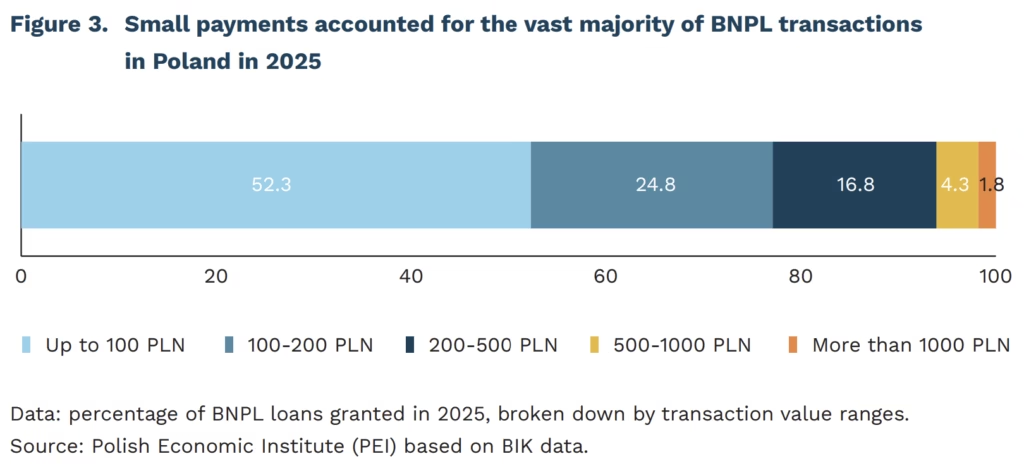
BNPL instruments play a specific role in the financial market, serving almost exclusively to defer low-value consumer expenditures in the short term. As much as 98.2% of payments made this way last year were for amounts up to 1,000 PLN, with more than half of them (52.3%) not exceeding 100 PLN. This model differs from traditional installment loans, where financing amounts under 1,000 PLN account for just 8.6% of total sales. From the perspective of household budgets, Poles report using this mechanism most often for clothing purchases (22% of respondents) and electronics and audio-visual equipment (20% each), valuing above all the ability to postpone payment for their purchases.
Deferred payments have become a channel for bringing consumers into the formal credit system in Poland. Given the steadily shrinking base of individual customers actively using traditional loans, first-time borrowers using BNPL accounted for as much as 20.5% of all new customers in 2025, second only in size to the group opting for standard installment plans. Crucially, from a demographic perspective, as many as 41.5% of this group are people under the age of 24, for whom BNPL was their first experience with debt. Such a first experience often paves the way for a broader presence in the financial market – 54% of customers who start with BNPL later turn to other forms of credit, most often choosing traditional instalment credit for purchases (75.1%) or installment loans (61.1%).
Customers who use deferred payments demonstrate a high level of payment discipline, which, in the long run, helps them build a positive credit history. As many as 75.6% of transactions in 2025 were paid off during the interest-free period. Analyses show that less than 1% of BNPL users experience payment delays exceeding 30 days, which is a noticeably better result than for any other credit or loan product. Timely repayment of these small but numerous obligations is recorded in credit information databases, allowing individuals with limited credit history to gradually demonstrate their reliability to financial institutions.
The growing share of BNPL transactions in the digital economy is changing consumers’ relationship with debt and savings. Treating deferred payments merely as an integrated feature of the shopping cart can distort perceptions of the actual financial burden. While this tool does allow consumers to protect their current savings from unexpected expenses and optimize payments for online purchases, a lack of control over many small credit limits can easily lead to a buildup of debt. The ultimate impact of BNPL on the stability of household budgets depends on consumers’ ability to maintain discipline in their repayments.
7 BIK (the Credit Information Bureau) is Poland’s main credit bureau, established under the Banking Law by banks and the Polish Bank Association, which collects and shares information on the credit history of individuals and businesses.
Jakub Witczak
Dynamic growth in ICT services trade with the US
4% y/y growth in the value of Polish services exports in 2025
40% share of Polish services exports were delivered to Germany, the US and the UK in 2025
22% share of Polish ICT services exports were delivered to the US in 2025
In 2025, the value of services provided from Poland to foreign customers rose by 4% y/y, from PLN 471 billion to PLN 488 billion.8 Poland’s position in services trade relative to other EU Member States remained unchanged. It continues to rank 9th in exports to the EU market and 11th in services provided outside the EU. The services balance declined for the second consecutive year (-5%). Exports still significantly exceed imports of services into Poland, but the gap has narrowed in recent years owing to faster import growth (+9% y/y in 2025).
For the past two years, the largest category of Polish services exports has been other business services (including business-related services) rather than transport services. In 2025, transport services accounted for 26% of exports and other business services for 28%. Transport services reached their highest share of Polish exports in 2021-2022 and have since fallen by 3 percentage points. Meanwhile, the share of other business services failed to increase for the first time since 2021. Over the past decade, the most pronounced change has been in the share of travel, which has been declining steadily since 2010. In 2024 and 2025 it stood at 12%, half its level of ten years earlier.
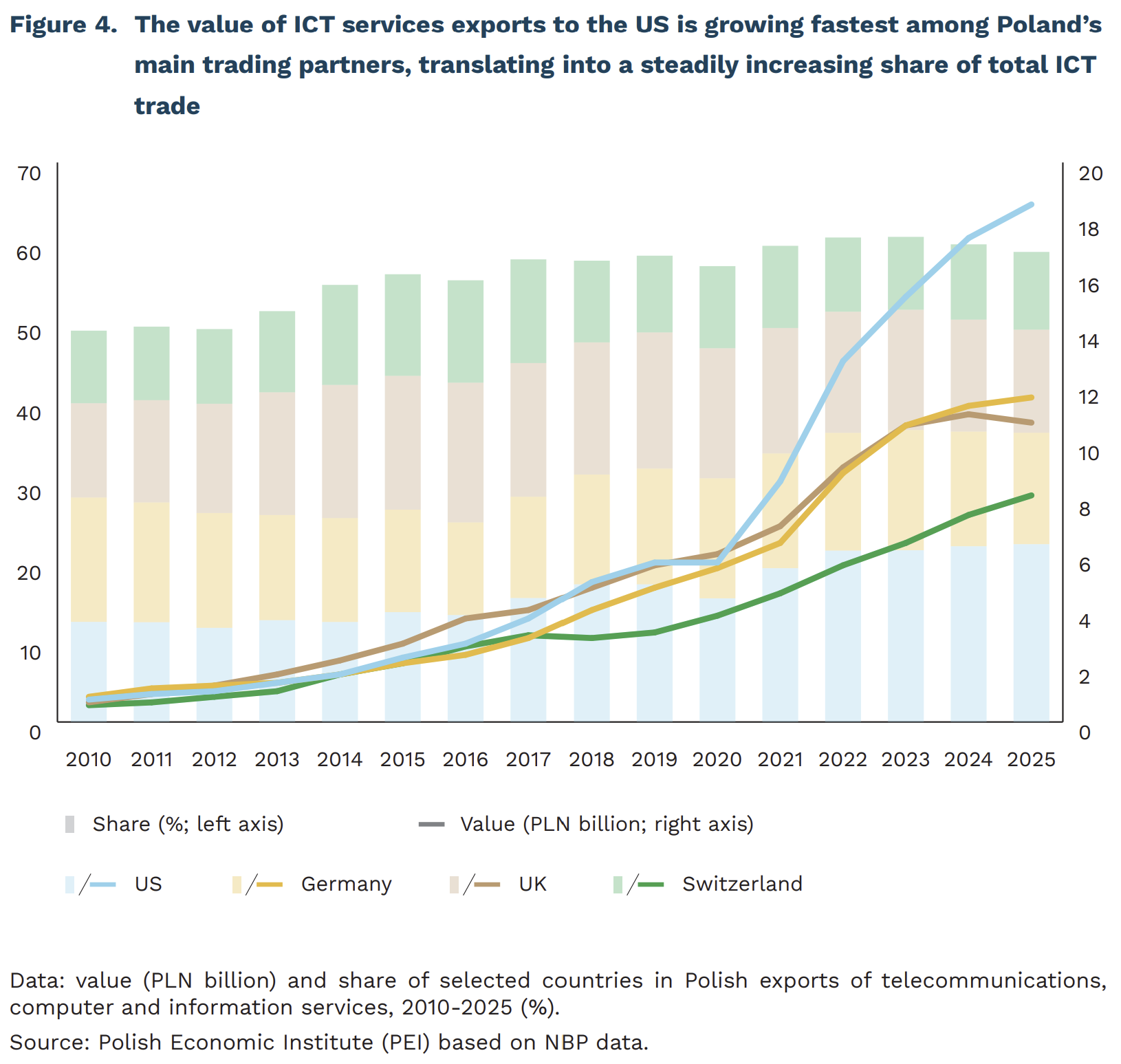
Between 2021 and 2025, the total value of services exports to the US doubled, while the value of services supplied from Poland to Germany increased by half. Germany, the US and the UK have long been the main recipients of Polish services, accounting for a combined 40% of Poland’s total services exports in 2025. Within this group, Germany has consistently been by far the largest recipient, with a 22% share of exports in 2025. Its share, like those of other partners, has remained virtually unchanged for many years. The exception is the United States, the only country whose share of Polish services exports has increased (by 2.2 pp compared with 2021). The total value of services exports to the US almost doubled, from PLN 25.8 billion in 2021 to PLN 50.9 billion in 2025.
ICT services recorded the strongest growth. They are currently the third most important category of Polish services exports, accounting for 17% in 2025 (PLN 83 billion), compared with just 6% of total services exports in 2010 (PLN 6 billion). This growth reflects the overall expansion of the ICT industry worldwide and is further supported by Poland’s favourable position in global supply chains, which in turn requires a suitable environment for the ICT industry. The development of the sector in Poland itself is also a key factor. Around 60% of Polish ICT services exports9 in 2025 (PLN 48.8 billion) went to the US, Germany, Switzerland and the UK, with one third of this amount delivered to the United States (22% of the total, PLN 18 billion).
The value of Polish services exports has been growing uninterruptedly for more than a decade (by an average of 11% annually since 2010, with the only decline, of 4%, recorded in 2020). However, both the structure of services supplied and their destinations are gradually shifting. Other business services and transport services continue to lead, but travel has declined significantly in favour of ICT services. Germany also remains the most important destination for Polish services exports. However, this may change over time, if the current pace of growth in Polish services exports to the US, particularly in the ICT sector, is sustained.
8 Own calculations based on NBP data from 06.10.2026.
9 In this analysis, ICT services are defined broadly, in line with the Extended Balance of Payments Services Classification (EBOPS), as telecommunications, computer and information services (code SI).
Katarzyna Sierocińska
