
Effects of the US–China trade war on international supply chains
Press release
Published: 16/05/2020
In mid-February 2020, the Economic and Trade Agreement (ETA) between the United States and China entered into force. It constituted the first stage of a broader trade deal between the two countries (the so-called Phase One Deal). In practice, the agreement did not significantly reduce the level of protectionism in US–China trade. Additional tariffs still cover around two-thirds of US imports from China and 80% of Chinese imports from the United States. The Polish Economic Institute report “The effects of the US–China trade war on international supply chains” attempts to assess the impact of the trade war to date on changes in global trade, with particular attention to the European Union and Poland. In the face of the coronavirus pandemic, the struggle between the two powers for global dominance may take an unexpected turn.
The Polish Economic Institute report “The effects of the US–China trade war on international supply chains” attempts to assess the impact of the trade war to date on changes in global trade, with particular attention to the European Union and Poland. In the face of the coronavirus pandemic, the struggle between the two powers for global dominance may take an unexpected turn.
The Economic and Trade Agreement between the United States and China obligated China, among other things, to purchase USD 200 billion worth of US goods and services in 2020–2021—a target that from the outset appeared ambitious. In the context of the coronavirus pandemic, meeting this commitment will be even more difficult.
Restrictive measures introduced by the Chinese authorities in January 2020 led to a decline in both domestic and import demand for goods and services in China, explains Łukasz Ambroziak, analyst in the Foreign Trade Team at the Polish Economic Institute. Moreover, factory shutdowns resulted in serious disruptions to global supply chains.
The latest data from the International Monetary Fund indicate that the coronavirus epidemic will reduce China’s GDP growth in 2020 to 1.2%, the lowest level in more than four decades. This will lower demand not only for imported consumer goods, but also for intermediate goods and raw materials used in industrial processing. As a result, concerns are growing about China’s ability to fulfill its commitments to purchase US goods and services.
The US–China trade war forms part of a broader debate on systemic changes in the global economy, and the coronavirus pandemic will undoubtedly accelerate these changes. Discussions will increasingly focus on developing a new paradigm for the functioning of the global economy. Until now, this paradigm has been based primarily on minimizing production costs. The epidemic has shown that this mechanism of global supply chains can be unreliable. Other factors, such as security of supply, are also becoming increasingly important, adds Łukasz Ambroziak.
The US–China trade war before the coronavirus outbreak
Before the crisis caused by the SARS-CoV-2 epidemic, the world was focused on the trade dispute between the United States and China. Rarely in recent decades has the global economy experienced such a sharp escalation of protectionist measures as those observed since early 2018 in US–China trade.
Within less than two years, the average tariff rate on US imports from China rose from 3% to 21% by early 2020, while tariffs on Chinese imports from the United States increased from 8% to 21%. Ultimately, additional tariffs imposed as part of the trade war covered approximately 3% of global merchandise trade.
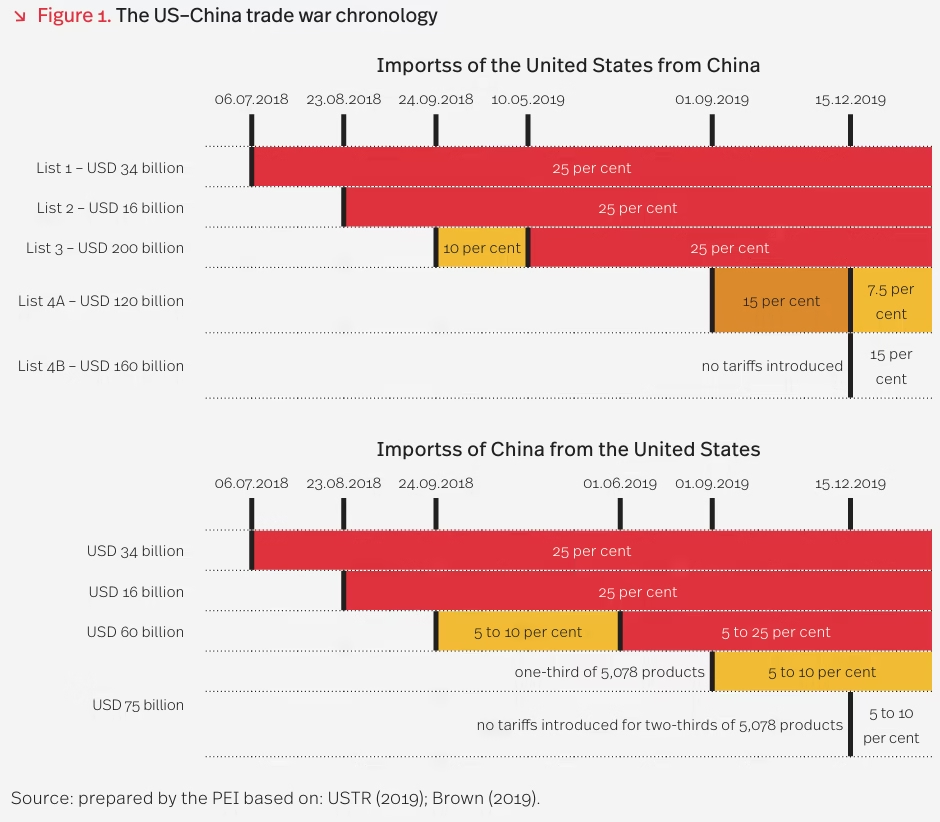
As Łukasz Ambroziak points out, sanctions in mutual trade contributed to a collapse in US–China merchandise trade in 2019. At the same time, other countries benefited—both as suppliers of goods to the United States and China and as recipients of US and Chinese exports. The largest beneficiaries of the trade war were Vietnam and Taiwan, which significantly increased their exports to the United States. In particular, the trade war contributed to an almost 10% increase in Poland’s imports from China, leading to a deepening of Poland’s trade deficit with China, which reached EUR 26.5 billion in 2019.
***
The Polish Economic Institute is a public economic think tank with a history dating back to 1928. Its main research areas include foreign trade, macroeconomics, energy, and the digital economy, as well as strategic analyses of key areas of social and public life in Poland. The Institute prepares analyses and expert studies supporting the implementation of the Strategy for Responsible Development and promotes Polish research in economic and social sciences domestically and internationally.
Media contact:
Paweł Leszczyński
Senior Communications Specialist
E-mail: pawel.leszczynski@pie.net.pl
Tel.: +48 789 387 682
