
Further development of nuclear energy requires a long-term, coherent strategy
Press release
Published: 09/04/2026
Poland remains highly dependent on imports of energy carriers, while at the same time entering a decisive phase of transformation of its power sector. The scenario for the future energy mix should extend beyond the perspective of 2040. The development of nuclear energy, as one of its pillars, requires a comprehensive approach to the structure of the energy market and the planning of, among others, long-term financing frameworks for projects going beyond the construction of Poland’s first nuclear power plant, as well as streamlining regulations for nuclear investments. At the same time, it should be assumed that SMRs (small modular reactors) will not solve the problem of the capacity gap over the next 10–15 years, and it is necessary to develop both a roadmap for the most effective applications of this technology and the required public support mechanisms for their development. These are the key conclusions of the Polish Economic Institute report “Unlocking Nuclear Energy in Poland: Policy, Regulatory and Industry Incentives”
In 2024, imports accounted for 16% of annual consumption of steam coal, 18% of coking coal, and as much as 84% of natural gas used in the industrial sector. At the same time, Poland faces high emissions in the power sector (nearly 600 g CO₂ equivalent per kWh produced—almost three times higher than the EU-27 average) and the need to replace aging coal-based generation capacity.
“High electricity prices in Poland, rising emissions in the power sector, and the prospect of increasing natural gas imports mean that there is a risk of a deepening negative balance in Poland’s electricity market in the coming years. Combined with the challenge of growing energy demand—resulting, among other things, from the progressing electrification of the economy and efforts to reduce dependence on fossil fuel imports—we need a debate on the conditions under which Poland should effectively and rapidly implement nuclear energy. At the same time, nuclear energy should not be treated as a single investment, but as a strategic programme requiring institutional, regulatory, and market coherence,” emphasizes Dr. Adam Juszczak, Senior Advisor in the Energy Team.
The special role of nuclear energy in Poland’s future energy mix
Nuclear energy is a key instrument for building a secure, low-emission, and competitive power system. Its development can reduce imports of fossil fuels and electricity, as demonstrated by data from EU countries using nuclear energy—most of them are net exporters of electricity, while also meeting their domestic energy needs. At the same time, the construction of new low-emission generation sources (including nuclear power plants) is driven by growing energy demand in the economy. Electricity consumption in Poland reached 167.5 TWh in 2025, and it is projected that by 2050, in the case of large-scale electrification and a climate neutrality scenario, it could increase to as much as 345–471 TWh annually.
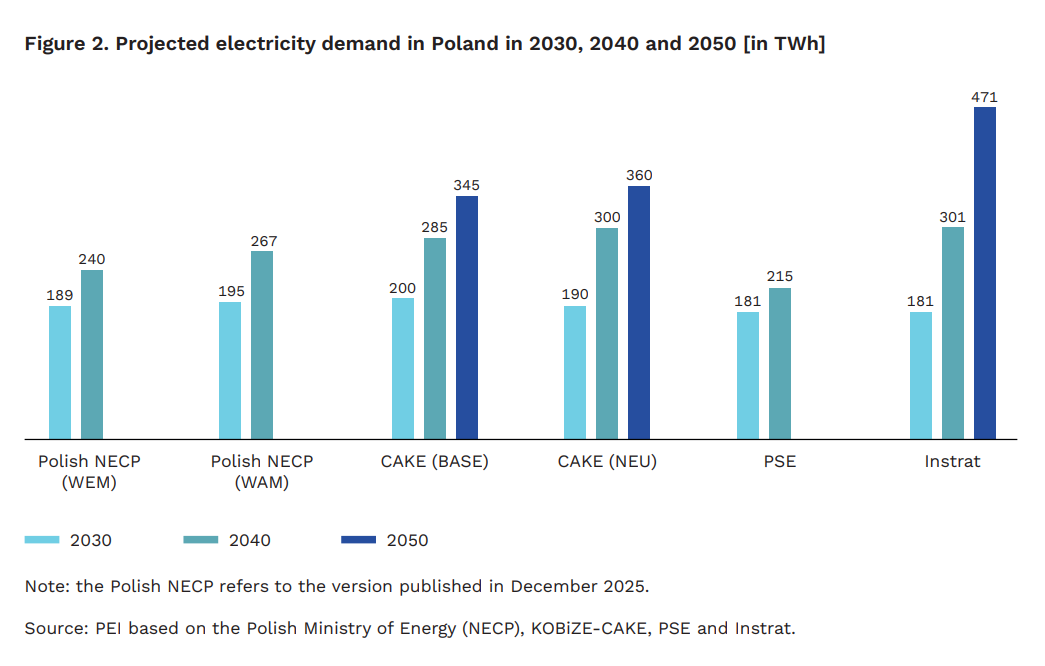
The success of the energy transition in Poland will depend, among other factors, on the effective implementation of nuclear energy, which—combined with the use of renewable energy sources—will ensure lower system operating costs. However, the effective use of both technologies requires the development of a long-term scenario extending beyond the middle of the 21st century.
“According to 60% of experts participating in the qualitative study conducted by the Polish Economic Institute (PIE), nuclear energy could cover at least 20% of Poland’s electricity demand before 2050. At the same time, a long-term energy transition strategy should take into account the expansion of nuclear capacity over a longer horizon. Efforts should be made to avoid a scenario in which conservative electricity demand forecasts combined with rapid development of renewables lead to an ill-conceived and inefficient technology mix, resulting in different technologies crowding each other out of the market and making it more difficult to achieve climate neutrality efficiently. Such a situation would risk a persistently low utilization rate of nuclear power,” emphasizes Dr. Eng. Krzysztof Krawiec, Advisor in the Energy Team at PIE.
SMRs are an important but still uncertain response to the needs of energy-intensive industries
Small modular reactors (SMRs) are seen as a solution providing a stable, low-emission source of energy for industry, as well as for district heating and cogeneration applications. Unlike the first large-scale nuclear power plant, which will be located in northern Poland, six BWRX-300 reactors are planned to be located in central and southern Poland, near industrial facilities in the metallurgical sector (Dąbrowa Górnicza), the chemical industry (Stawy Monowskie near Oświęcim and Włocławek), the petrochemical industry (Płock), and heavy industry (Tarnobrzeg and Stalowa Wola).
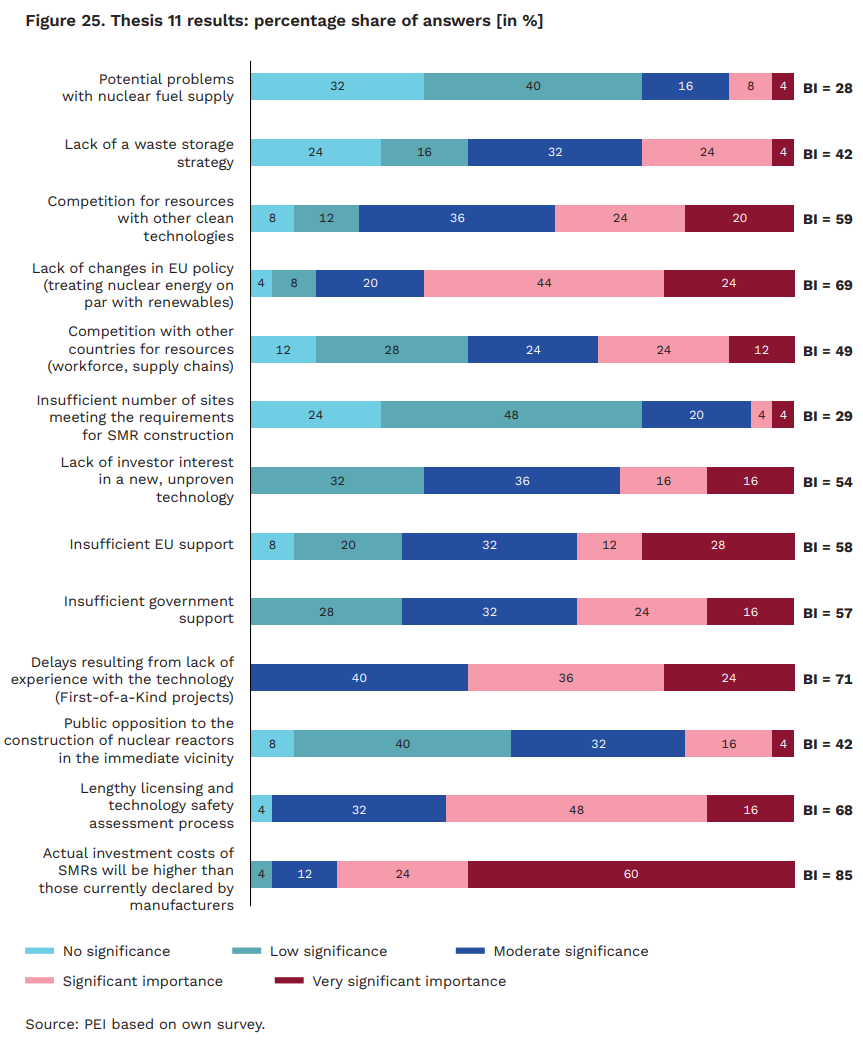
Key advantages of this concept include proximity to industrial consumers, lower reactor capacity allowing better adjustment to industrial needs, lower water consumption compared to large-scale reactors, and the ability to produce district heat. However, experts participating in the PIE study pointed to the low technological maturity of SMRs and barriers to their development, including the risk of higher-than-expected investment costs and potential delays resulting from technological immaturity, especially in initial projects. They also emphasized low institutional readiness, including the lack of real EU support for nuclear energy and the lengthy licensing process.
“From an industrial perspective, the key risk for SMR projects is the combination of high costs and implementation delays. For energy-intensive industries, nuclear energy is not an end in itself but a factor that can enhance competitiveness by providing a potential source of affordable, stable, and low-emission electricity and— in the case of SMRs—also industrial heat. If cheaper and less risky decarbonization alternatives become available in the meantime, market interest may decline significantly,” notes Wojciech Żelisko, Senior Analyst in the Energy Team.
SMR projects currently remain a solution with very limited availability—in practice, they are still largely at the pilot and demonstration stage. It is worth noting that while Poland’s first nuclear power plant in Lubiatowo-Kopalino will be financed with state participation, with the approval of the European Commission, under a contract-for-difference model, the financing of other investments—particularly SMRs—remains an open question. As SMR technology enters the phase of commercial availability, it will primarily be accessible to the largest economic entities. For example, the cost of building four BWRX reactors in Ontario is estimated at approximately CAD 21 billion (PLN 56 billion). The construction of even a single such reactor is therefore beyond the reach of the vast majority of companies operating in Poland. The relatively high unit costs of SMRs, compared to other solutions, indicate the important role of state support in their financing. This support may take the form of co-financing projects (e.g., within industrial zones) or credit guarantees.
The development of nuclear energy requires legal changes
Among the necessary directions for regulatory changes, experts identify the following:
- Allowing broader preparatory work before obtaining the final construction permit.
Current regulations only allow for early site preparation (land leveling, temporary fencing, power supply, but solely for construction purposes). A draft law proposing appropriate solutions was adopted by the Council of Ministers on 24 March 2026.
- Structuring the process of the general assessment of the reference design, combined with a schedule for issuing permits and licenses.
At present, the same reactor—if it were to be built in multiple locations—would have to undergo the full licensing procedure each time, including aspects already assessed in previous proceedings. The possibility of certification is only partially replaced by the option of obtaining a “general opinion of the President of the National Atomic Energy Agency (PAA)”, but the process for obtaining it is not structured, and the scope of pre-licensing activities depends on the content of the application submitted by the investor.
- Broader acceptance of English-language documentation in formal proceedings.
Currently, all documents forming the basis for formal decisions (such as construction licenses) must be submitted in Polish. Given the shortage of nuclear experts in Poland, it is difficult to find sufficiently experienced personnel capable of translating English-language documentation into Polish.
- Extensive cooperation with foreign nuclear regulatory authorities—modeled on the aviation sector.
Under such a model, the Polish regulator would retain the authority to assess documentation and issue final decisions, but there would be close cooperation with foreign regulators—similar to aviation, where the European Union Aviation Safety Agency (EASA) acts as a validation authority vis-à-vis non-European regulators (e.g. the US Federal Aviation Administration), which conducts the primary assessment process.
***
The Polish Economic Institute is a public economic think tank with a history dating back to 1928. Its main research areas include macroeconomics, energy and climate, the global economy, economic foresight, digital economy, sustainable development, and behavioral economics. The Institute prepares reports, analyses, and policy recommendations on key areas of the Polish economy and society, taking into account the international context.
Media Contact:
Ewa Balicka-Sawiak
Press Officer
T: +48 727 427 918
E: ewa.balicka@pie.net.pl
