
Economic Weekly 27/2025, July 11, 2025
Published: 11/07/2025
Table of contents
Median Wages Increase by 15% Year-on-Year in January 2025
99% share of counties where median wages rose year-on-year in January 2025
30% year-on-year increase in median wages in the ‘Education’ sector (NACE section) in January 2025
97% share of municipalities, median wages increased year-on-year in January 2025
In January 2025, the median gross wage for employees under employment contracts rose by 15.3% compared to the previous year, reaching PLN 6,882. This indicates that half of all employees earned more than this amount, while the other half earned less. The median wage for women was approximately PLN 6,734, and for men PLN 7,033. The data is derived from the monthly decile wage distribution published by the Central Statistical Office (GUS) with a six-month delay. It covers all employees working under employment contracts in both the public and private sectors and includes all wage components such as bonuses, time-based allowances, and awards. It is important to note that this data does not encompass all workers. Employees working under civil law contracts (mandate contracts and specific-task contracts), commonly used by younger workers, are excluded. Also excluded are self-employed individuals running sole proprietorships, who often earn higher incomes, especially in the ‘Information and Communication’ sector (NACE section).
The use of median and decile distribution measures provides a more accurate picture of the income situation than the arithmetic mean, which tends to be skewed upward by high wages in the upper distribution ranges. At the beginning of 2025, the average wage was 21% higher than the median, amounting to PLN 8,717.
Based on data covering individuals employed under employment contracts, wage inequality within this group has slightly decreased. The income inequality ratio, [1] measured as the ratio of the 90th to the 10th percentile of wages (P90/P10), fell from 3.16 in January 2024 to 3.07 in January 2025. This indicator should not be interpreted as a measure of income inequality for the entire economy.
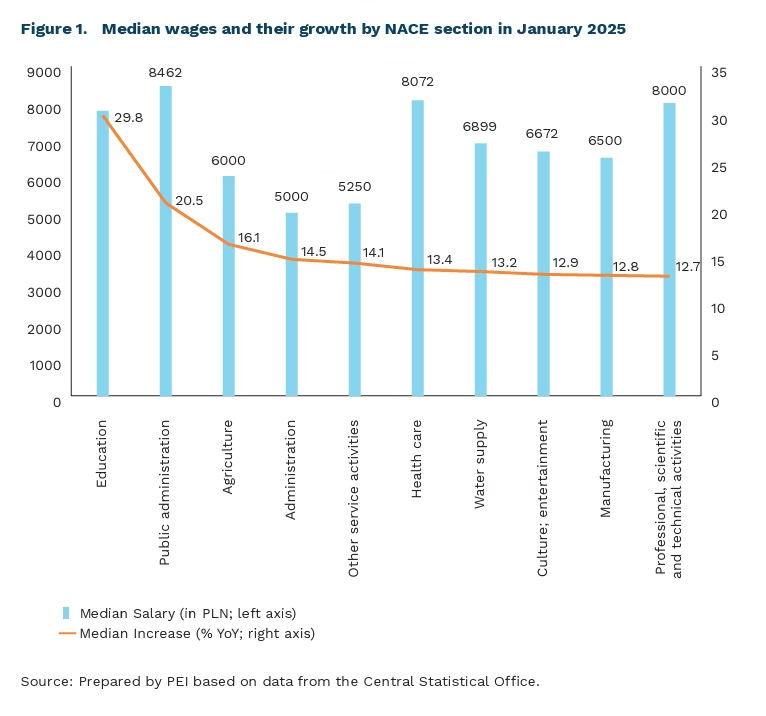
Wage growth varied significantly across sectors. In most NACE sections sections, median wage growth ranged from 10% to 16%. The strongest increases were recorded in sectors dominated by public entities: education (29.2%) and public administration (20.2%). The only sector to record a decline in median wages was ‘Mining and quarrying,’ down by 0.7%. Nevertheless, this sector remains among the best paid, with a median salary of PLN 10,125 in January 2025 – the third highest nationally after ‘Information and communication’ (PLN 11,098) and ‘Electricity, gas, steam and hot water supply’ (PLN 10,392).
Wage growth showed some geographic variation but was generally quite evenly distributed. Median wages increased in 97% of municipalities, 100% of urban counties, and 99.4% of rural counties. As in the previous year, the highest wages under employment contracts were observed in mining regions (such as Głogów and Polkowice counties) and in Warsaw and its surrounding municipalities (such as Łomianki and Podkowa Leśna).
- This measure compares the income (or wages) of individuals at the 90th percentile of the distribution, that is, those who earn more than 90% of the population, with the income of individuals at the 10th percentile, who earn more than only 10% of the population. It serves as an indicator of income dispersion and inequality within a society and is often used when data on decile sizes are unavailable, making it impossible to calculate the two most common measures of inequality: the Gini coefficient and the Palma ratio.
Tomasz Mądry, Jakub Witczak
The English Language National High School Exam Showed the Greatest Variation Among Voivodeship Capitals
8 points difference in the average score on the mathematics national high school exam between schools in voivodeship capitals and schools in counties without a voivodeship capital
5 points difference in the average score on the Polish language national high school exam score between schools in voivodeship capitals and schools in counties without a voivodeship capital
10 points difference in the average scoreon the English language national high school exam score between schools in voivodeship capitals and schools in counties without a voivodeship capital
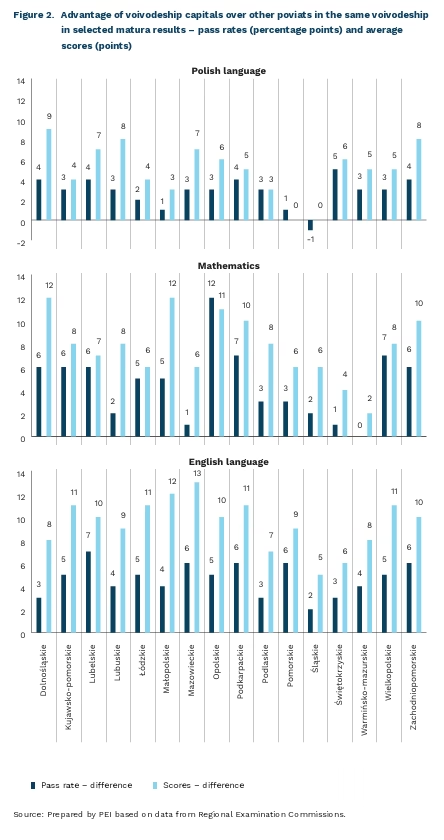
The results of the secondary school leaving (Matura) examinations show clear differences between schools located in voivodeship capitals and those located in counties without a voivodeship capital. For each voivodship, we compared the results achieved by students attending schools in voivodship capitals and in other counties in the voivodship in three core subjects: mathematics, Polish, and English. We took into account the percentage of students who passed the exam in each subject (pass rate) and the average number of points obtained (score). These indicators are weighted averages considering the number of students taking the exam in individual counties.
In mathematics, the difference in pass rates between voivodeship capitals and counties without provincial cities is 4 percentage points, and the average score is 8 points higher in favour of the capitals. Significant differences are visible in Opolskie Voivodeship, where the pass rate in Opole was 12% higher and the average score 11 points higher than in other poviats. Large differences between the capital and the rest of the voivodeship can also be observed in Kraków and Wrocław (a 12-point difference). The smallest differences are found in Warmińsko-Mazurskie Voivodeship.
The results in the Polish language show smaller regional differences. Across the entire country, the difference in pass rates between voivodeship capitals and schools in other counties is 2 percentage points, while the difference in average scores is 5 points. In Katowice, the percentage of students passing the exam was even lower than the average in other counties of the Śląskie Voivodeship. Minimal differences in the analysed indicators are also observed in the Pomorskie Voivodeship – Gdańsk does not stand out in terms of average scores in this subject within its voivodeship. The greatest disparities in average Polish exam results between voivodeship capitals and counties without a provincial city are seen in the Dolnośląskie, Zachodniopomorskie, and Lubuskie Voivodeships, although in each case these differences are smaller than those observed in mathematics (below 10 points).
The English language exam proved to be the most differentiating in terms of points scored. Nationwide, the differences in pass rates between capitals and counties without provincial cities amount to 5 percentage points, and the difference in average scores is 10 points. In schools located in the capitals of half of the voivodeships, average scores were 10 or more points higher than in other counties of the same voivodeship. The largest difference favouring the provincial centre is in the Mazowieckie Voivodeship – students in Warsaw scored 13 points higher than students in other Mazowieckie poviats. The smallest differences are observed in the Śląskie and Świętokrzyskie Voivodeships. In terms of pass rates, the differences between voivodeship capitals and other counties do not exceed 7 percentage points anywhere, with the smallest difference (2 percentage points) in the Śląskie Voivodeship.
Relatively small differences in the exam pass rates across most voivodeships may indicate similar basic educational opportunities for young people. Larger differences in results may suggest that outside major urban centres there is a lack of resources and options to fully realise students’ potential (e.g., access to tutoring or attracting talents to bigger cities).
Łukasz Baszczak
Most University Graduates Remain in the Voivodeship Where They Studied
Almost 160,000 second-cycle graduates who obtained their diplomas in 2023
Nearly 80% graduates from universities in the Podkarpackie Voivodeship who remained in the region
Over 37% graduates from universities in the Warmińsko-Mazurskie Voivodeship relocated to another voivodeship after obtaining their master’s degree
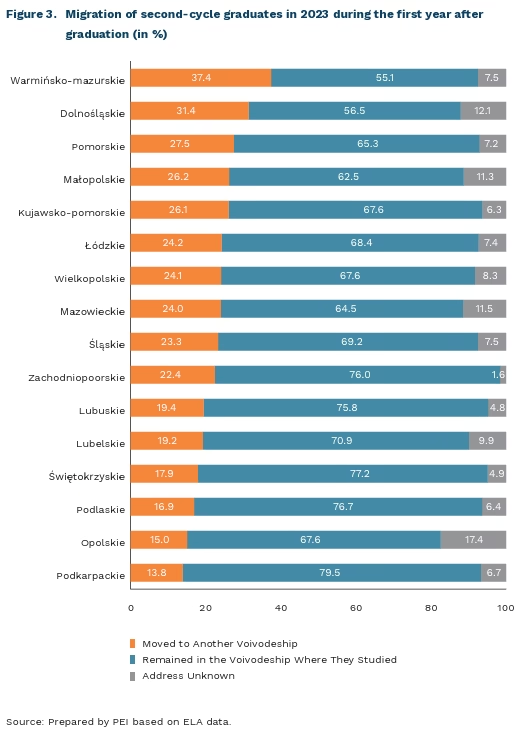
In 2023, 159,221 students completed second-cycle studies. Their migration during the first year after graduation is tracked by the ELA (Graduate Tracking System), detailed in the latest, 10th edition. The report titled Geographical Mobility provides insights on graduates from universities across individual voivodeships. Each voivodeship has a dedicated chapter outlining the percentage of graduates who remained in the voivodeship where they studied, those who relocated, and the specific voivodeships to which graduates moved during their first year after completing second-cycle studies.
More than half of second-cycle graduates remain in the voivodeship where they studied during their first year after graduation. The highest retention rate is in the Podkarpackie Voivodeship, where 79.5% of graduates stayed. Other voivodeships with notably high retention rates include Świętokrzyskie (77.2%), Podlaskie (76.7%), Zachodniopomorskie (76%), and Lubuskie (75.8%).
Among the voivodeships with the highest outflow of second-cycle graduates are Warmińsko-Mazurskie and Dolnośląskie. In both, over 30% of graduates relocate to another voivodeship after completing their studies. Graduates from the Warmińsko- Mazurskie Voivodeship most often move to Mazowieckie (14.1%) or Pomorskie (8.2%). Meanwhile, graduates from Dolnośląskie tend to move to neighbouring voivodeships such as Wielkopolskie (6.7%), Opolskie (5%), and Lubuskie (3.3%).
Mazowieckie clearly attracts graduates from all over Poland. There is no voivodship from which some of the graduates would not settle in the Mazowieckie Voivodship after obtaining a master’s degree. As many as 14.1% of graduates from universities in the Warmińsko-Mazurskie Voivodeship moved to Mazovia in the first year after obtaining their degree. A fairly large percentage of graduates migrating to the capital can also be found in the Lubelskie Voivodeship (9.1%) and Podlaskie Voivodeship (6.4%). If we add to this the fact that 64.5% of graduates studying in the Mazowieckie Voivodship remain there after There is no voivodship from which some of the graduates would not settle in the Mazowieckie Voivodship after obtaining a master’s degree. As many as 14.1% of graduates from universities in the Warmińsko-Mazurskie Voivodeship moved to Mazovia in the first year after obtaining their degree. A fairly large percentage of graduates migrating to the capital can also be found in the Lubelskie Voivodeship (9.1%) and Podlaskie Voivodeship (6.4%). If we add to this the fact that 64.5% of graduates studying in the Mazowieckie Voivodship remain there after graduation, we can see that this voivodship not only draws on the resources educated in the voivodship itself, but also attracts graduates from other voivodships.
Data from the ELA system is an important source of knowledge about the mobility of graduates and the economic aspects of their decisions. An analysis of geographical movements at the voivodship level provides important information about the resources of the population with higher education remaining in and leaving the region. By additionally analysing other information about graduates contained in the ELA system, concerning their job search time and salaries after graduation, it is possible to try to explain the decisions made regarding changing place of residence after graduation. Analyses already carried out by experts show that there is a positive but not very strong correlation between the propensity to migrate and the profitability of leaving. This suggests that non-economic factors, such as social ties, living costs and the quality of the working environment, may also play an important role in decisions to change place of residence after graduation.
Katarzyna Dębkowska
Trump’s Bill Will Deepen Debt and Inequality
6.6% decline in average income of the poorest decile of US households between 2026 and 2034 due to the combined effects of the OBBBA and tariffs
183% of GDP projected level of US public debt in 2054 if the bill’s provisions are maintained, compared to 142% without its implementation
1.2 percentage points increase added to the long-term yield on 10-year US bonds
One Big Beautiful Bill Act (OBBBA) – Donald Trump’s flagship economic reform passed Congress by a narrow majority. Despite its ‘big & beautiful’ rhetoric promising increased prosperity, the bill functions as a fiscal time bomb: it benefits the wealthiest while shifting costs onto the broader society.
The bill includes extending the reduced tax rates introduced in 2017, introducing allowances for overtime and tips, eliminating incentives for investing in green energy, and increasing military spending. At the same time, it provides for social spending cuts totaling approximately USD 930 billion, mainly affecting the Medicaid and SNAP programs, which benefit the poorest populations.
The OBBBA Act is a highly regressive reform package that may stimulate economic growth in the short term but is expected to destabilize public finances and deepen inequality in the long term. The tax and expenditure costs over the decade will amount to USD 2.4 trillion, and when debt servicing costs are included, this could rise to between USD 3.0 and 5.0 trillion if the relief measures become permanent. By 2054, the debtto-GDP ratio could reach 183%. While the bill is projected to increase economic growth by approximately 0.2 percentage points annually between 2025 and 2027, it is expected to raise interest rates and crowd out private investment over the longer term. By 2054, US GDP could be 2.9% lower than it would be without the reform.
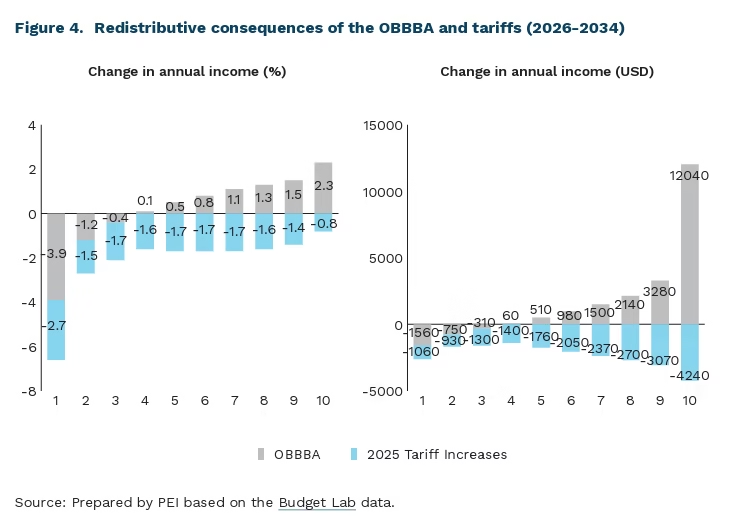
The reform package disproportionately benefits the wealthiest at the expense of the poorest. According to Budget Lab data, the combined effect of the OBBBA and tariffs will reduce the income of the poorest 10% of households by 6.6%, while increasing income for the wealthiest 10% by 1.5%. This means the greatest burden falls on the poorest, with gains concentrated among the wealthiest. Tariffs further exacerbate inequality by disproportionately impacting low-income consumers through higher prices on everyday goods. Budget Lab estimates that the new tariffs alone account for a significant share of the losses borne by lower-income groups, worsening their real impoverishment. The Congressional Budget Office (CBO) and Joint Committee on Taxation (JCT) estimate that 68% of the bill’s total benefits will accrue to the wealthiest 10%, while over 16 million people (about 5% of the population) could lose access to Medicaid. The Tax Policy Center adds that households earning over USD 217,000 annually will receive approximately 60% of the tax breaks, whereas those earning less than USD 35,000 will receive only about 1% of the total benefits.
One of the most significant consequences of the OBBBA is the rise in US Treasury bond yields driven by increased debt supply and inflation expectations linked to fiscal expansion. However, this effect is not confined to the United States alone. Yields on European bonds, including Polish 10-year bonds, tend to move in correlation with US yields. When investors demand higher risk premiums for holding US debt, similar pressure emerges in other markets. Consequently, the cost of servicing public debt may increase if global capital shifts towards more attractive US bonds, assuming the US retains its status as a safe haven for investors
Sebastian Sajnóg
At the Beginning of the 21st Century, German Banks Stopped Granting Loans to German Industry
2,999 to 1,285 number of banks in Germany decreased between 1999 and 2025
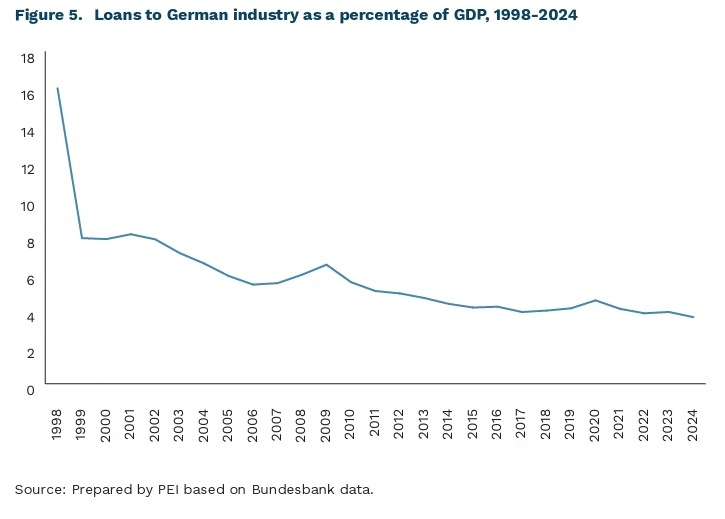
16% to 3% ratio of loans to industrial companies to GDP fell between 1998 and 2024
3 times decline in the value of domestic company shares held by German banks between 1999 and 2025
The German economy continues to struggle to recover from a prolonged period of stagnation. Recent industrial production data indicate a modest rebound in May, while the June PMI index edged closer to the 50-point threshold, signalling a potential return to growth in the industrial sector. However, as Wolfgang Münchau points out in his recently published book, Kaput. The End of the German Economic Miracle, the challenges facing the German economy are fundamentally structural. A critical weak spot remains the banking system, which for decades served as a cornerstone of industrial financing but is now steadily losing this role.
Traditionally, Germany’s bank-centered financial system provided domestic industry with stable, long-term funding. This insulated companies from the pressures of stock market shareholders demanding rapid returns, allowing them to pursue long-term investments. Banks extended credit based on intimate knowledge of their clients, often through capital ties, enabling more effective risk management. These long-term financing relationships fostered investments in human capital, research and development, supplier partnerships, and production organisation. This framework was pivotal to the competitive strength of German industry, especially among medium-sized enterprises. While similar models existed elsewhere, Germany’s Hausbank system persisted longest and on the largest scale. Yet, the foundations of this model are clearly weakening in the 21st century.
In the 21st century, lending to industrial companies in Germany collapsed. In 1998, the industrial sector held EUR 331 billion in loans, whereas by 2024 this figure had fallen to only EUR 150 billion (with cumulative inflation over this period at 60%). These amounts correspond to 16% and 3% of GDP, respectively. The 21st century also witnessed a significant reduction in the number of banks: from 2,999 in 1999 to just 1,285 today. While consolidation of the banking system does not necessarily imply reduced lending, the decline in the number of banks and the resulting breakdown of long-term relationships between banks and companies could undermine the traditional role of banks in financing key economic sectors. This may contribute to diminished innovation and a shift towards short-term thinking. Münchau highlights the lag in electromobility development and the emissions measurement scandals as examples of these issues. A decline in innovation is also apparent among small and medium-sized enterprises (SMEs). According to the German development bank KfW (Kreditanstalt für Wiederaufbau), the share of SMEs introducing innovations was over 40% in the early 2000s but dropped to between 19% and 22% during 2017-2020 [2].
The decline in lending activity may stem from the reduced direct control banks once had over companies, which in turn increased the risk of the loans granted. In 1999, the German banking system held shares in domestic companies valued at EUR 46 billion; by 2025, this had fallen to just EUR 15 billion. Ownership of shares in client firms was a cornerstone of the Hausbank system, facilitating its effective operation. This trend signals that the German economy has lost a crucial element that once supported its industrial sector
2. Recent reports show this figure rising to 40%, but this increase is due to a change in methodology.
Michał Kowalski
Electrification Will Drive Change in Heavy Road Transport, but Diesel Will Remain Difficult to Replace
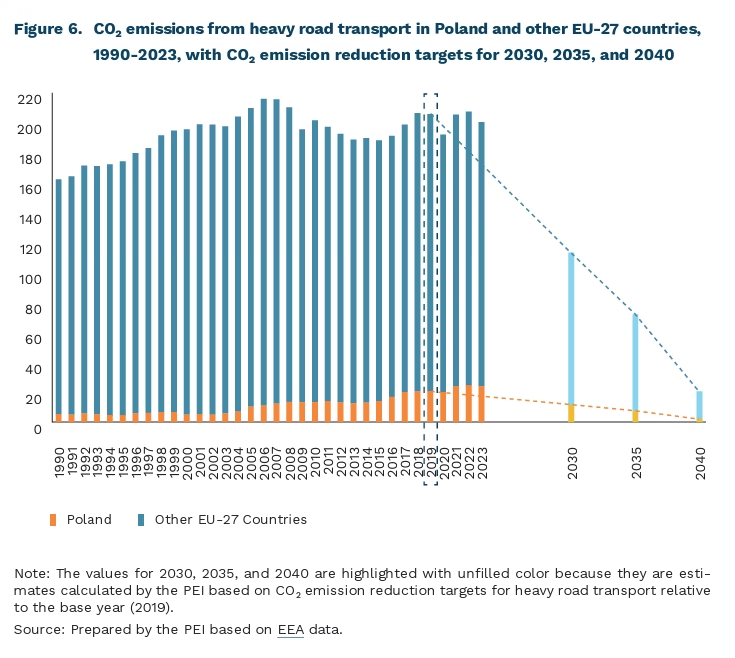
200 million tonnes CO₂ emitted by heavy road transport in the EU in 2023
90% EU’s proposed target for net greenhouse gas reduction by 2040
36-39% estimated share of electric (24-25%) and hydrogen (12-14%) trucks in the EU fleet by 2040, according to the European Commission
Achieving the European Commission’s target of a 90% reduction in net greenhouse gas emissions across the European Union by 2040 will require profound changes in the transport sector. In 2023, the sector emitted 786 million tonnes of CO₂, representing 31.5% of total EU CO₂ emissions. Road transport was the dominant source, accounting for 95% of emissions within the transport sector.
Heavy road transport contributed 27% of road transport emissions in the EU, releasing 200 million tonnes of CO₂ in 2023. Achieving large-scale emission reductions in this segment has long been recognised as particularly challenging due to its high energy intensity (IEA) and the difficulty of replacing oil on a large scale (JRC). Consistent with the EU’s commitment to climate neutrality by 2050, emission reduction targets have been established for new trucks and coaches by 45% by 2030, 65% by 2035, and 90% by 2040 compared to 2019 levels.
According to the European Commission’s calculations, by the end of 2024, the EU’s fleet of zero-emission heavy trucks included over 15,000 battery-electric trucks and only 170 hydrogen-powered trucks. Zero-emission vehicles accounted for just 2.1% of new truck sales in the EU. This remains very low considering that in 2023, more than 4 million trucks were in operation across the EU, with Poland having the largest share at 727,000 vehicles.
The European Commission projects that battery-electric trucks will remain the dominant zero-emission technology until 2030, with hydrogen trucks gradually introduced after 2025. By 2040, electric trucks are expected to comprise 24-25% of the EU heavy truck fleet, while hydrogen trucks will account for 12-14%, depending on the scenario. To achieve these targets, the EU will need approximately 945,000 new battery-electric trucks and 480,000 new hydrogen trucks by 2040.
From Poland’s perspective, decarbonising heavy road transport remains a significant challenge, partly due to the sector’s high fragmentation. Of the 140,000 companies operating in the Transport, Shipping, and Logistics (TSL) sector, 97% are micro-enterprises, with an average workforce of just six employees per company. While this structure has historically allowed flexibility to meet dynamic transport demand, it may hinder costly investments in zero-emission vehicles due to smaller firms’ greater difficulty accessing capital.
Krzysztof Krawiec
Algorithmic Content Selection on Social Media Is One Source of Social Polarization
64.7% percentage of the global population using social media
75.6% percentage of Poles using social media
Algorithms on social media platforms can indirectly influence the positions of political parties, according to an article by Nobel laureate in economics Daron Acemoğlu and other researchers. The article presents a theoretical model of social media dynamics, where political parties tailor their narratives to the polarization at the extremes of the electorate, adopting more radical positions than before.
Algorithmic content curation on social media is a significant driver of social polarization. In this model, platform AI algorithms aim to maximize user engagement by creating so-called filter bubbles. Within these bubbles, users are less likely to encounter information that challenges their existing views.
Researchers argue that social media platforms exploit filter bubbles to maximize profits by promoting content of lower credibility or quality within them. By showing users aligned but lower-quality content, platforms reduce the risk of such content being flagged as misinformation, which could lead to reduced advertising revenue. Conversely, credible content that conflicts with users’ views receives less exposure inside the bubble, as platforms have little incentive to promote it.
The polarizing effect on voters is expected to be stronger among those with more extreme views. The lower the credibility of the content, the smaller and more extreme the filter bubbles become, thereby exerting a greater influence on voters with radical opinions. Conversely, voters with moderate views are less likely to be influenced by low-quality content, both because they have a lower chance of entering such filter bubbles and because algorithms tend to show them higher-quality content, recognizing them as better-networked users.
The assumptions presented in the article are based on a theoretical model developed by the authors. Empirical analysis is significantly hindered by social media platforms themselves, which effectively restrict researchers’ ability to conduct studies and collect data. This lack of transparency raises concerns, especially considering that 64.7% of the global population and 75.6% of the Polish population use social media. Notably, in the European Union, the Digital Services Act requires platforms to provide data for research purposes, potentially enabling deeper understanding of their impact in the future.
The authors emphasize the need for external intervention, as the socially harmful mechanisms described have become an integral part of platform operations. Potentially positive measures include increasing content diversity to expose users to a broader range of material, as well as enforcing greater platform transparency – initiative already underway in the EU through relevant regulations. Additionally, improving digital literacy is crucial, as better-informed users are less susceptible to manipulative messaging on these platforms.
