
Lithuania, Luxembourg, the Netherlands, and Poland are the countries least economically affected by the COVID-19 crisis
Press release
Published: 08/08/2022
In 2020, the crisis hit Southern Europe the hardest. The Economic Forecast Index (EFI) developed by the Polish Economic Institute (PIE) shows that Greece, Spain, and Croatia suffered the most severe economic consequences among EU countries. During the first wave of the pandemic, OECD countries protected up to 50 million jobs, which, among other effects, led to an increase in public debt in developed countries by 20 percentage points. These are the main conclusions of the latest PIE report “Pandenomics 2.0. How European countries coped with the second wave of the pandemic, the economic recession, and what scenarios await us in 2021.”
In 2020, the crisis hit Southern Europe the hardest. The Economic Forecast Index (EFI) developed by the Polish Economic Institute (PIE) shows that Greece, Spain, and Croatia suffered the most severe economic consequences among EU countries. During the first wave of the pandemic, OECD countries protected up to 50 million jobs, which, among other effects, led to an increase in public debt in developed countries by 20 percentage points. These are the main conclusions of the latest PIE report “Pandenomics 2.0. How European countries coped with the second wave of the pandemic, the economic recession, and what scenarios await us in 2021.”
Due to the specific nature of the pandemic, comparing the current situation across countries requires continuous updates. For this reason, PIE prepared the second edition of the Pandenomics report, which attempts to assess the economic and epidemiological situation in European countries in 2020.
As part of a cluster analysis, PIE experts identified four groups of countries with similar epidemiological characteristics and comparable data in terms of infection rates, mortality, and the scale of restrictions introduced:
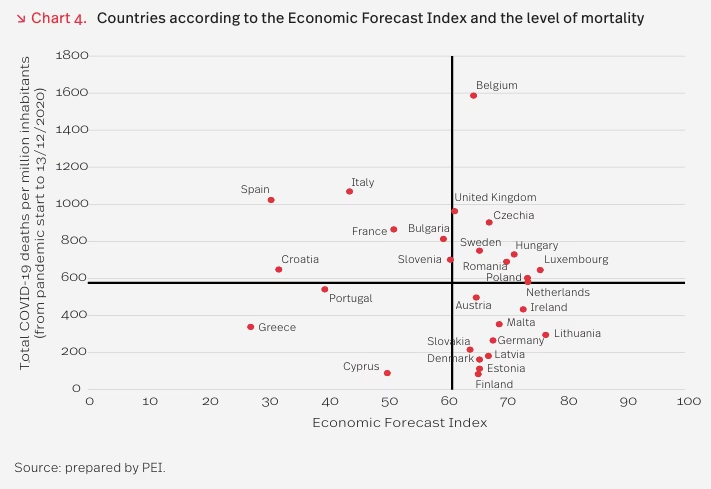
- Group 1 – “Countries most severely hit and locked down by the pandemic” includes seven countries: Belgium, France, Ireland, Italy, Portugal, Spain, and the United Kingdom. These countries recorded the highest infection and mortality rates during the first wave of the pandemic. During the second wave, these indicators were average compared to other groups, but the level of economic restrictions remained relatively high throughout the crisis.
- Group 2 – “Countries with a deteriorating situation” consists of fifteen countries: Austria, Bulgaria, Croatia, Cyprus, Czechia, Germany, Greece, Hungary, Lithuania, Malta, the Netherlands, Poland, Romania, Slovakia, and Slovenia. During the first wave, they recorded the lowest infection and mortality rates, with moderate restrictions compared to other groups. However, these countries were much more severely affected during the second wave, with high infection and mortality rates and relatively moderate government restrictions.
- Group 3 – “Lucky losers” includes four countries: Denmark, Estonia, Finland, and Latvia. They recorded the fewest cases and relatively low mortality rates during both the first and second waves of the pandemic.
- Group 4 – “The lagging duo” consists of Sweden and Luxembourg.
Economic consequences of fighting the pandemic
To precisely assess the economic slowdown in the EU-27 and the United Kingdom, PIE developed a new indicator—the Economic Forecast Index (EFI). It combines forecasts of GDP, unemployment, budget deficit, public debt, as well as imports and exports. These six variables were used to create rankings of European countries based on economic forecasts for 2020 published before the pandemic and during the pandemic in autumn 2020.
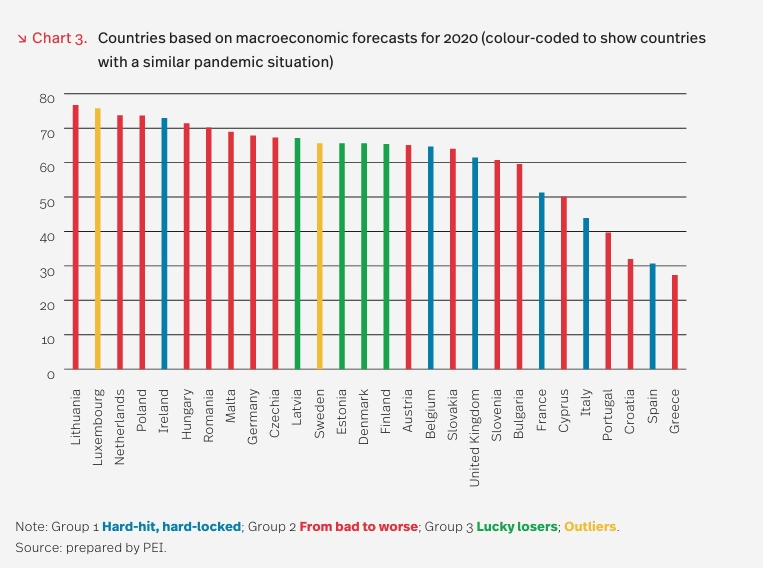
“The year 2020 will become a reference point in the history of the global economy. The crisis caused by the COVID-19 pandemic represents the strongest shock to economies—both developed and emerging—in decades. Our analyses show that countries most affected by the pandemic in terms of infections and deaths, and those that imposed the strictest lockdowns, suffered the most economically. In contrast, countries that coped relatively well with the first wave or applied fewer restrictions perform better in the final rankings,” said Andrzej Kubisiak, Deputy Director of PIE.
What scenarios does 2021 hold?
“The epidemiological situation in 2020 was directly linked to economic activity and influenced economic indicators. Therefore, when considering forecasts and prospects for 2021, the further development of the pandemic plays a key role in all analyses. In our view, the situation may develop in three possible directions. For Poland, we assume the implementation of a realistic scenario this year, which would enable GDP growth of 4.2%,” said Andrzej Kubisiak, Deputy Director of PIE.
The optimistic scenario assumes that the pandemic is brought under control in the first half of 2021. Vaccines are approved by relevant agencies at the end of 2020 or at the beginning of 2021. The rollout phase is prepared and implemented without major disruptions, and most people worldwide are willing to be vaccinated. As a result, rapid vaccinations begin in early 2021, and by mid-2021 most particularly vulnerable groups are vaccinated. Consequently, the number of COVID-19 cases requiring intensive care drops significantly, and after summer 2021 restrictions are no longer necessary.
The realistic scenario assumes that the pandemic is brought under control in the second half of 2021. In some cases, regulatory procedures related to vaccines are extended, meaning not all producers are able to deliver the expected number of doses by the end of 2020. Vaccine rollout is slowed by logistical and organizational obstacles, and a significant share of the population is unwilling to be vaccinated. Restrictions continue until autumn 2021.
In the pessimistic scenario, the pandemic is brought under control in 2022. Mass vaccination is delayed (e.g. due to shortcomings in clinical trials or emerging doubts about vaccine safety). As a result, seasonal peaks in infections are observed not only in 2021 but also in 2022. Restrictions and lockdowns continue throughout 2022.
***
The Polish Economic Institute is a public economic think tank with a history dating back to 1928. Its main research areas include foreign trade, macroeconomics, energy, and the digital economy, as well as strategic analyses of key areas of social and public life in Poland. The Institute prepares analyses and expert studies supporting the implementation of the Strategy for Responsible Development and promotes Polish research in economic and social sciences domestically and internationally.
Media contact:
Ewa Balicka-Sawiak
Press Officer
T: +48 727 427 918
E: ewa.balicka@pie.net.pl
