
Poland and Supplements: Opportunities for European leadership
Press release
Published: 10/12/2019
The dietary supplements market in Poland was worth PLN 4.4 billion in 2017, and its value has been growing dynamically. Although almost half of Poles (48%) consume supplements regularly, only 27% are able to define them correctly. A lack of knowledge about the regulations governing the sale of dietary supplements and the possible effects of their use is one of the main problems of this market, as indicated in the Polish Economic Institute (PIE) report “Regulation of the dietary supplements market. Does Poland have a chance to become a European leader?”
Losses resulting from tax avoidance and profit shifting to tax havens amount to as The dietary supplements market is currently not subject to regulations that would simultaneously ensure safety while preserving freedom of choice. This is largely due to a lack of awareness of what dietary supplements are and how they differ from over-the-counter medicines. As the report shows, 45% of Poles are convinced that dietary supplements are tested for effectiveness, and as many as 43% believe that they are subject to the same supervisory standards as medicines.
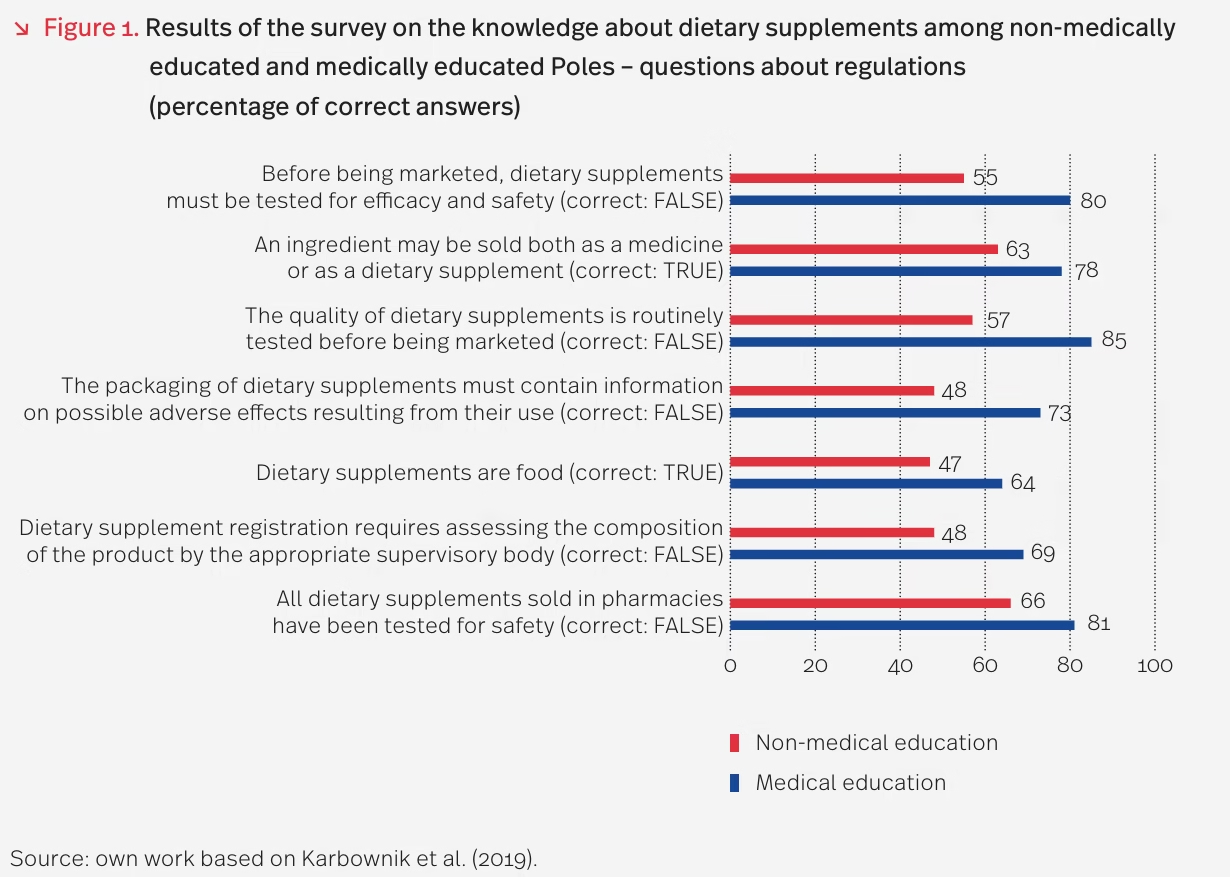
According to Adam Czerwiński, analyst in the Strategy Team at the Polish Economic Institute, in reality the safety of dietary supplement use is questionable. This is due to insufficient institutional oversight of the market, low entry barriers for new products and producers, and the absence of adequate regulations guaranteeing safety, he explains.
Ensuring sufficient safeguards for the Polish dietary supplements market is all the more important given its rapid growth. Over the past decade, its value has increased more than threefold—from PLN 1.7 billion (EUR 0.4 billion) in 2008 to PLN 4.4 billion (EUR 1.05 billion) in 2017. Forecasts indicate that in the near future the market is expected to grow by around 5% annually.
Proposed recommendations
Adam Czerwiński primarily proposes the introduction of a registration fee for new dietary supplements at the Chief Sanitary Inspectorate (GIS), as well as improving the efficiency of this institution by increasing its budget. In particular, this refers to laboratory testing of supplements available on the market, which would verify declared composition and microbiological purity, explains the analyst.
In 2018, 6.24% of dietary supplement inspections conducted by the GIS resulted in a negative, disqualifying outcome. There is significant room for optimization, as the initial verification of a dietary supplement currently takes the GIS an average of two years. It is worth noting that during this period, the product may still be available for retail sale.
Other recommendations include increasing consumer awareness by improving the register of products subject to notification upon first placement on the market, as well as amending regulations on advertising and packaging. Proposed measures include, among others:
- introducing a requirement to clearly inform consumers that a product is a dietary supplement and does not provide health benefits,
- banning advertising that implies clinical effectiveness,
- increasing penalties for non-compliant advertising.
In addition, the report recommends introducing electronic healthcare systems to improve communication between doctors and patients, adds Adam Czerwiński.
***
The Polish Economic Institute is a public economic think tank with a history dating back to 1928. Its main research areas include foreign trade, macroeconomics, energy, and the digital economy, as well as strategic analyses of key areas of social and public life in Poland. The Institute prepares analyses and expert studies supporting the implementation of the Strategy for Responsible Development and promotes Polish research in economic and social sciences domestically and internationally.
Media contact:
Andrzej Kubisiak
Head of the Communication Team
E-mail: andrzej.kubisiak@pie.net.pl
Tel.: +48 512 176 030
