
Poland on the map of “green” trade
Press release
Published: 28/12/2020
Green trade is a sector worth hundreds of billions of euros that is set to become a pillar of the global economic recovery after the COVID-19 pandemic. Although Poland currently ranks near the bottom of global listings of the “greenest” countries, it is one of the largest exporters of environmentally friendly goods in Europe and worldwide. The sector—worth up to USD 1.5 trillion—faces challenges, including China’s control over exports of rare earth metals. These issues are discussed in the latest Polish Economic Institute report “Poland on the map of ‘green’ trade.”
Around 8% of global exports consist of “green” products, amounting to approximately USD 1.5 trillion. The European Union is one of the regions aspiring to global leadership in this sector; in 2018, its trade surplus in green goods reached USD 100 billion. Poland is among the world’s leading green exporters, selling, among others, equipment for generating electricity from renewable sources and gas-filtering components. For example, exports of the latter amounted to USD 757 million in 2018.
Poland’s significant role
Poland ranks 5th among EU exporters in terms of the value of green product exports and 15th globally, accounting for 2% of world trade in this category. Between 2010 and 2018, the value of Poland’s exports of environmentally and climate-friendly products doubled, reaching USD 26 billion. Exports of products used for generating electricity from renewable energy sources reached USD 2.7 billion over the same period.
The growth rate of exports in both categories exceeded the growth of Poland’s total exports, amounting to 78% and 122%, respectively, during the analyzed period. The share of environmentally friendly products in Polish exports reached 10% in 2019.
Although Poland ranks only 106th out of 130 countries in the global “green economy” ranking, exports of green products have a positive impact on two key macroeconomic indicators: GDP and the unemployment rate. Poland should support the production of environmentally friendly technologies and goods through trade financing, which could help exporters better exploit green export opportunities and, in the long run, bring tangible benefits to both the environment and the economy, says Maciej Miniszewski, analyst at the Polish Economic Institute.
An analysis of the product structure of Polish exports indicates the absence of clear export “champions” and relatively large differences among leading products depending on the classification used. Among products related to renewable energy, Poland is successfully building export potential in batteries. Given growing comparative advantages and an increasing export share of these products, Poland is well positioned to attract further investment in environmentally friendly sectors.
What is the “green economy”?
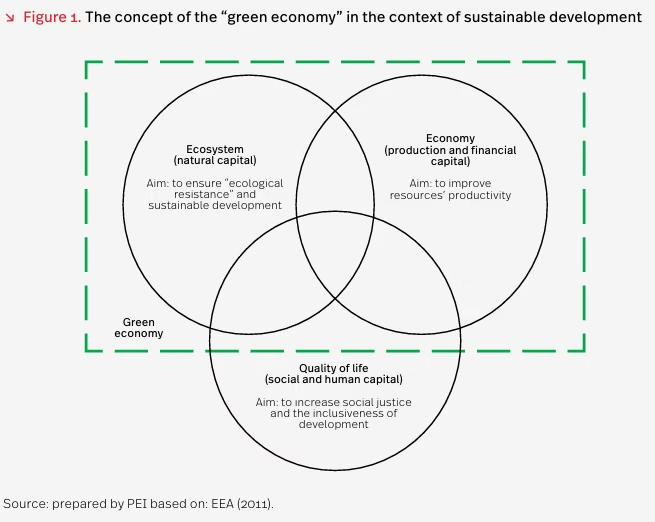
The debate on the green economy gained prominence after the 2008–2010 financial crisis, which exposed structural problems in economies and societies. Two key future challenges identified at the time were progressing climate change and dependence on traditional energy resources. The concept of the green economy emerged as a feasible response to these accumulated problems.
The key characteristics of the green economy include:
- improving material and energy efficiency (decoupling resource use from economic growth),
- transitioning to a circular economy,
- shifting costs to polluters and greenhouse gas emitters,
- energy transformation and replacing non-renewable sources with renewable ones.
An uncertain global future
Previous achievements—such as the development of renewable energy sources—have been driven by international trade, as falling technology prices increased their competitiveness relative to conventional energy. In the coming years, green trade is expected to grow in importance thanks to investments in low-emission transformation as part of the post-COVID-19 economic recovery.
Depending on the definition of “green” products, their exports in 2018 ranged from USD 0.5 trillion to USD 1.5 trillion, accounting for 3–8% of global exports. Between 2010 and 2018, their value increased by 10–32%. Under a broad definition of the green economy, this growth exceeded the expansion of global trade overall, which amounted to 24.5%.
Factors such as increasing productivity of photovoltaic panels and economies of scale led to an 85% decline in unit prices between 2009 and 2019. Although the value of photovoltaic panel exports fell by more than 28% between 2010 and 2018, their volume increased by 52%. A likely slowdown in further price declines and the continued growing importance of renewable energy sources are expected to lead to renewed growth in the value of trade in these products, says Marek Wąsiński, Head of the International Trade Team at the Polish Economic Institute.
Political factors will also play a role. As China is the largest producer of rare earth metals, used among others in low-emission technologies, there is a risk that Beijing could decide to restrict supplies of rare earths and certain products made from them. This could increase prices of many environmentally friendly technologies and consequently slow the green economic transformation. Therefore, reducing dependence on supplies from China is one of the key objectives of the trade policies of both the EU and the United States. However, this is a long-term and costly process, which may be further complicated by the COVID-19 pandemic.
The dominant players in green trade are the world’s largest economies. The EU, China, and the United States account for over 60% of global exports of green products (including intra- and extra-EU trade). Five economies—together with Japan and South Korea—account for three-quarters of global exports. The EU records a trade surplus in green goods, China’s balance depends on the adopted definition of green trade, while the United States runs a deficit in all cases.
***
The Polish Economic Institute is a public economic think tank with a history dating back to 1928. Its main research areas include foreign trade, macroeconomics, energy, and the digital economy, as well as strategic analyses of key areas of social and public life in Poland. The Institute prepares analyses and expert studies supporting the implementation of the Strategy for Responsible Development and promotes Polish research in economic and social sciences domestically and internationally.
Media contact:
Marcel Lesik
Senior Communications Specialist
T: +48 510 814 659
E: marcel.lesik@pie.net.pl
