
The middle class in Poland. Does the Polish self-made man exist?
Press release
Published: 15/12/2019
The size of the middle class in Poland exceeds the population of countries such as Denmark or Sweden, according to the latest report by the Polish Economic Institute (PIE) entitled “The Middle Class in Poland. Does the Polish self-made man exist?” This places Poland among the leading European countries. Almost half of middle-class members (45%) have outstanding loans, and the same share have no savings at all. It is therefore not surprising that 55% of people classified as middle class expect the state to pursue an active policy of job creation.
The latest PIE report shows that, using income (economic) criteria, 54% of Poles aged 24–64 belong to the middle class. For comparison, 30% fall into the lower class and 16% into the upper class.
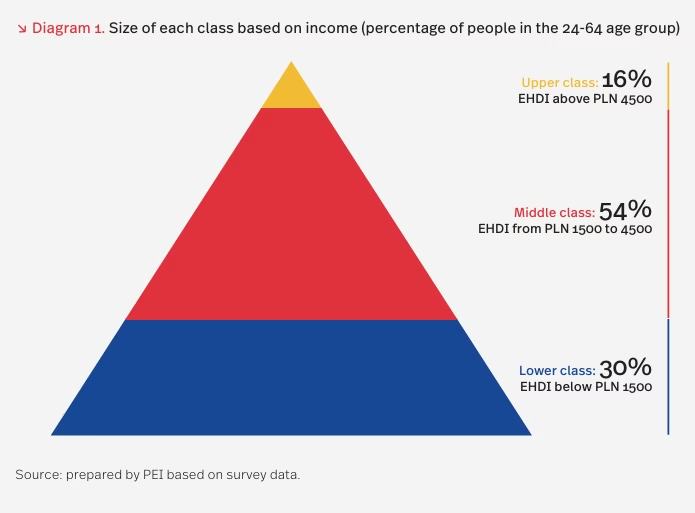
Similar proportions emerge when social class is defined using occupational (social) criteria, primarily related to education, qualifications, and position in the organizational hierarchy. Under this approach, 51% of people aged 24–64 can be classified as middle class, 37% as lower class, and 12% as upper class.
The presence of 11–12 million workers and consumers in the middle class relative to the total population places Poland among the European leaders. In this respect, Poland outperforms countries such as Russia, Lithuania, Hungary, as well as Portugal and Spain. Countries where the middle class constitutes the largest share of society include the United Kingdom, the Netherlands, and Norway, says Paula Kukołowicz, analyst at the Polish Economic Institute.
An interesting phenomenon is that when assessing their own income relative to others, Poles most often classify themselves as middle class. As many as 75% of Poles claim to belong to the 40% of people with average incomes. If the size of the middle class were based on subjective self-assessments, it would include 16.5 million people aged 24–64, rather than the 11–12 million meeting objective criteria.
Characteristics of the Polish middle class
Membership in the middle class in Poland is strongly linked to education. On average, 54% of upper-class members hold a university degree, compared with 26% of the middle class and only 5% of the lower class.
The median net equivalent disposable income per household member among middle-class individuals amounts to PLN 2,500.
An important aspect of the middle class is the aspirations of its members. When asked about desired income growth, middle-class respondents indicate that the income allowing for the comfortable satisfaction of family needs amounts on average to PLN 6,600 net per month. This is PLN 1,900 more than the currently measured average income of households in this group (PLN 4,700), adds Paula Kukołowicz.
45% of middle-class representatives declare that they have no savings at all. At the same time, data collected by PIE analysts show that 45% of middle-class members are burdened with various forms of loans and credits. This translates into a relatively low level of household debt in Poland compared to other European countries. In 2017, the total household debt amounted to 35.4% of GDP, significantly below the euro area average of 61.2% of GDP.
Members of the middle class relatively often work on a self-employed basis—this applies to 23% of them.
Views and attitudes
The middle class plays an important role in shaping social life; therefore, its views on key social issues are worth noting. 69% of middle-class respondents believe that the process of economic transformation has brought Poland only benefits or more benefits than costs.
At the same time, 55% of middle-class members agree that the state should play an active role in creating new jobs. The overwhelming majority of middle-class respondents support Poland’s membership in the European Union—70% believe it has brought only benefits or more benefits than drawbacks.
As regards priorities for public spending, middle-class preferences align with those of society as a whole, pointing primarily to healthcare and education.
***
The Polish Economic Institute is a public economic think tank with a history dating back to 1928. Its main research areas include foreign trade, macroeconomics, energy, and the digital economy, as well as strategic analyses of key areas of social and public life in Poland. The Institute prepares analyses and expert studies supporting the implementation of the Strategy for Responsible Development and promotes Polish research in economic and social sciences domestically and internationally.
Media contact:
Andrzej Kubisiak
Head of the Communication Team
E-mail: andrzej.kubisiak@pie.net.pl
Tel.: +48 512 176 030
