
The system of state aid in the EU affects the uneven development of member states
Press releaqs
Published: 22/07/2025
State aid for companies in the European Union is granted unevenly, especially in sectors considered key at the EU level, such as the energy transition. France and Germany accounted for 47% of all state aid granted in the EU in 2023, and as much as 52% in 2022. In 2023, there was particularly strong concentration of spending in the category “Environmental protection and energy saving” – it was almost three times higher than in the EU economy as a whole. The new mechanism, the Clean Industrial State Aid Framework (CISAF), adopted by the European Commission on June 25, 2025, does not radically change the rules for granting state aid in the EU, but focuses on the transition toward a low-emission economy. Nevertheless, its introduction may deepen the imbalance in the distribution of state aid in the EU. The solution proposed by Enrico Letta, introducing fees for excessive state aid, would make it possible to finance initiatives important for the single market in regions where less support has been provided. These are the main conclusions of the PIE report “Imbalance of State Aid in the European Union.”
Germany and France are the main beneficiaries of state aid
In 2023, the largest beneficiaries of aid were companies from Germany (€50 billion; 27% of all aid), France (€36 billion; 20%), and Italy (€21 billion; 12%). Poland spent €11 billion (6%). It is worth adding that the increase in Poland’s share of EU state aid in 2023 was largely related to addressing problems in the agricultural market caused by Russia’s invasion of Ukraine. In 2022, Poland’s share in EU state aid spending was only 2.8%, while Germany’s was 32%.
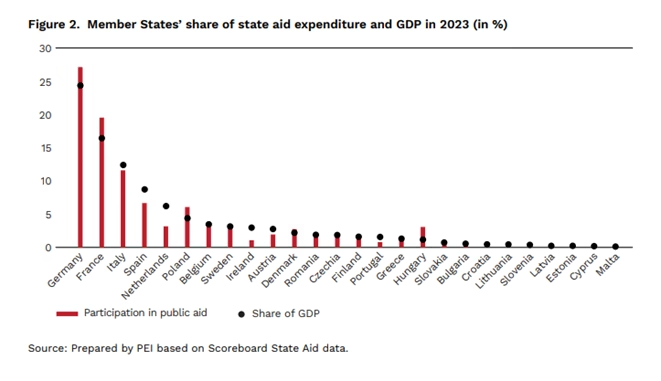
“The imbalance in the use of state aid in the EU results from the fact that the system is based on the actions of individual member states, not on coordination at the EU level. Aid provided directly by governments encourages a subsidy race between member states and gives companies the opportunity to negotiate support between countries. If state aid funds were coordinated at the EU level, this risk could be avoided,” notes Michał Kowalski, senior analyst in the global economy team at PIE.
The greatest concentration of state aid funds concerns environmental protection
In analyzing the impact of state aid, it is important to consider differences between sectors. In some of them, especially those most important for economic development, disparities are significantly greater than at the overall level of state aid granted on the single market. Particular attention is drawn to sectors related to the energy transition. The concentration of spending, measured by the Herfindahl–Hirschman Index (HHI), in the category “Environmental protection and energy saving” reached a value of 2480 HHI in 2023, while for the next most concentrated category, “Counteracting serious disturbances in the economy,” it was only 1758. This indicates that the area in which the European Commission plans to further relax the rules for granting state aid is one of the most unequal and concentrated within the entire structure of public support in the EU.
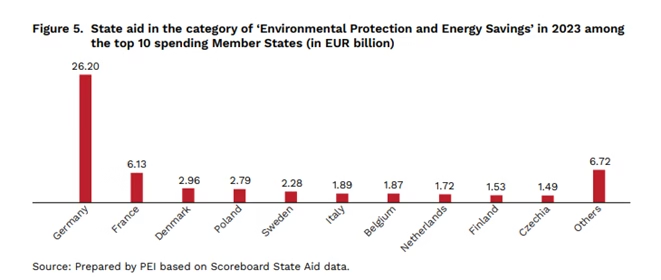
The existing state aid mechanism, the Temporary Crisis and Transition Framework (TCTF), was intended to counteract the effects of Russia’s invasion of Ukraine and support the transition toward a low-emission economy. The new mechanism, CISAF (Clean Industrial State Aid Framework), is intended solely for the latter purpose. Under the TCTF, Germany’s share of state aid spending amounted to 48% in 2022–2023. This suggests that the introduction of CISAF may deepen the imbalance of state aid in the EU.
Cross-country projects as a response to state aid imbalances in the EU
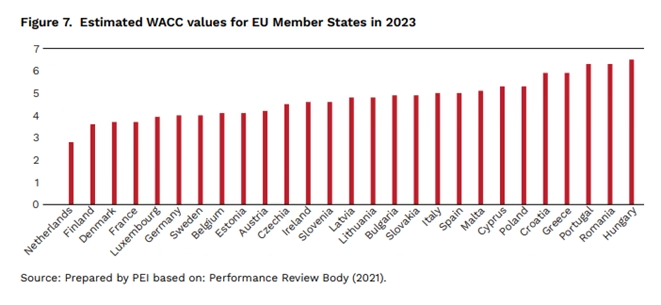
The rules for granting state aid should take into account the cost of capital. Under current conditions, situations often arise in which companies in countries with less developed capital markets struggle to obtain private funding, while at the same time competing with foreign companies that are both financially supported by their governments and have access to cheaper market financing. In general, the lower the cost of capital, the easier the access to private financing.
Inequalities in the use of state aid can also be reduced by supporting projects carried out simultaneously in several member states. Currently, in the EU they are implemented under the Important Projects of Common European Interest (IPCEI) instrument. Between 2018 and 2024, the European Commission approved €37 billion for 335 projects implemented in 22 member states under this mechanism. Strengthening this instrument should encourage member states to locate supply chains more broadly across the EU.
***
The Polish Economic Institute is a public economic think tank with a history dating back to 1928. The Institute prepares reports, analyses, and recommendations concerning key areas of the economy and social life in Poland, taking into account the international context. Its research areas include primarily macroeconomics, energy, the global economy, the digital economy, behavioral economics, and social processes.
Media contact:
Ewa Balicka-Sawiak
Press Spokesperson
P: +48 727 427 918
E: ewa.balicka@pie.net.pl
