
The Three Seas Initiative as an object of rivalry between China and the United States
Press release
Published: 20/12/2019
The rivalry between the United States and China is a clash between two global systems: the Bretton Woods monetary system and China’s Belt and Road Initiative, which is the nucleus of a parallel system. The coronavirus pandemic has accelerated changes in both systems and intensified frictions between them.For both players—the US and China—the Three Seas region is of particular importance. It is a belt stretching across 12 European countries, from Estonia through Poland to Bulgaria. Both the Three Seas region and the European Union will have to face the rivalry of these global actors, who make use of so-called sticky power. Today, this rivalry no longer concerns only influence over financial and monetary systems or civilizational identity—West versus Confucian values—but also control over 5G infrastructure and the international image related to responsibility for the outbreak of the pandemic. These are the conclusions of the Polish Economic Institute report “Belt and Road meets Three Seas. Chinese and American sticky power in the context of Polish security and other strategic interests.”
According to estimates based on the State Power Index of the In.Europa Institute, China and other Confucian countries have already surpassed Europe, the United States, and other Western states in many respects. This will affect the ethics of scientific research, public policy, and will lead to an evolution of global political systems. China’s growing power as a non-democratic, Confucian force has already alarmed the United States, which views China as a strategic rival.
China is introducing innovative solutions in areas such as artificial intelligence and global internet infrastructure, giving it significant influence over the digital transformation of global economies. The United States, for its part, has long promoted the development of global economic zones, notably through the Bretton Woods system. The approaches used by China and the US differ significantly, which may give rise to ethical disputes.
From the perspective of Western countries, initiatives such as One Belt, One Road, aimed at reviving the Silk Road, may be perceived as corruptive and as creating dependence on the Chinese economy. The total cost of this project is estimated at between USD 4 and 8 trillion, and cooperation agreements with China have already been signed by 125 countries, explains Piotr Arak, Director of the Polish Economic Institute.
The attention of both powers is drawn to the European Three Seas region, encompassing 12 Central and Eastern European countries that suffered from decades of communism and remain, to some extent, technologically and infrastructurally underdeveloped. As a result, they offer substantial investment potential and are of interest to both China and the United States. For China, the region serves as a gateway to Europe for the Belt and Road Initiative; for the United States, it constitutes a barrier to Russian and Chinese influence.
A particularly important area for both powers is digital security, which has already contributed to the escalation of the trade war. Both China and the United States are aware of the key role that 5G technology will play in emerging political and economic structures. Consequently, both powers seek to influence decisions taken by Three Seas countries regarding cooperation in this field.
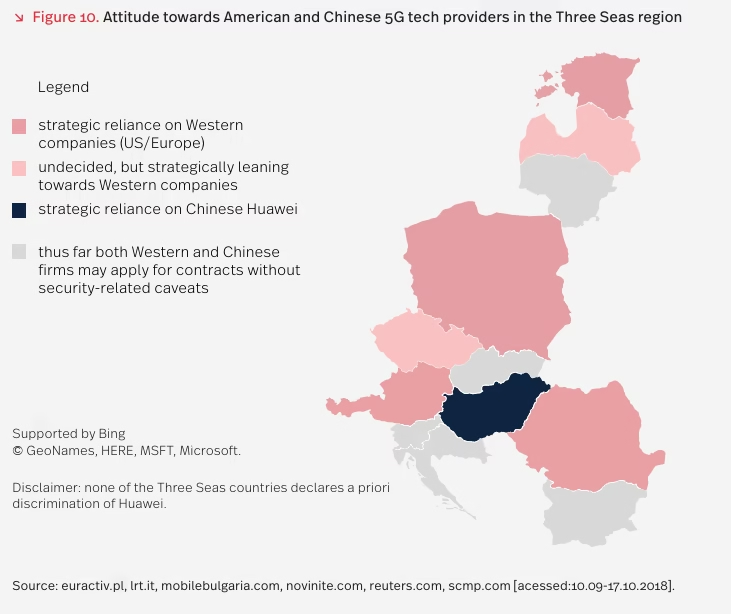
Poland and Romania prioritize partnerships with European and American companies, while countries such as Hungary lean toward Chinese firms. Bulgaria, in turn, does not appear to favor any strategic sphere of influence. For historical reasons, Poland associates its investment hopes with the West, while at the same time remaining interested in cooperation with China—visible, for example, in plans for the construction of the Central Transport Hub. This project includes the planned construction of 1,600 km of new railway lines, says Piotr Arak.
How will the coronavirus affect globalization?
In the context of the crisis caused by the SARS-CoV-2 pandemic, there is increasing discussion about reducing Western economies’ dependence on China (decoupling) and intensifying the relocation of production from China back to Western countries (reshoring). PIE analysts have already pointed out that reshoring began several years ago, primarily involving the transfer of production from China to India and Southeast Asian countries, and—following the US–China trade war—also back to the United States.
As explains Grzegorz Lewicki, author of the report and fellow at the Polish Economic Institute, these processes now appear necessary from a security perspective. When demand for disinfectants surged sharply in Poland in March 2020, it proved impossible to obtain key ingredients needed for their production. This disrupted Polish companies’ production chains and prevented delivery of final products. This occurred because producers in Germany and the Netherlands redirected key components to their domestic markets to support their own citizens first.
In the longer term, globalization is therefore likely to take on a more diversified and uneven form, resulting from temporary global slowdowns and accelerations affecting countries to varying degrees. The core of this “patchwork globalization” will be security, explains Grzegorz Lewicki. After the extreme experiences of the pandemic, states will begin to create experimental institutions enabling the temporary reduction of civilizational complexity in times of crisis. Their purpose will be the efficient and secure limitation of areas such as air transport, migration, or foreign production when sudden needs arise—for example, during a pandemic.
***
Expert discussion
On 17 June, an international expert discussion on the report took place. The full debate is available on the Polish Economic Institute’s YouTube channel.
Key observations from the panelists:
Tony van der Togt (Clingendael Institute, Netherlands)
In the short term, Russia poses a more serious threat to stability and security in Europe than China, particularly given its military potential. The EU should strengthen its geopolitical position and seek reciprocity in economic relations with China. Many countries recognize that the Belt and Road Initiative brings not only benefits but also serves Chinese strategic interests. Europe aims to reduce economic dependence on China, including by supporting European efforts to build a strong and independent digital industry.
Ian Brzeziński (Atlantic Council, USA)
In some respects, China poses a greater challenge to the West than the Soviet Union did during the Cold War. The Three Seas Initiative has added real value to the transatlantic community by strengthening Europe’s economic power. It should receive clear and systematic support from both the US and the EU. 5G technology should be one of the key priorities for Europe and the United States.
Alicia Garcia-Herrero (Bruegel Institute)
China’s ambitions are global, and the divide between the West and China is not only civilizational but also political. While China is an economic power, it lacks true sticky power. Weak multilateralism limits China’s ability to translate economic strength into political and military influence.
Lazar Comanescu (New Strategy Center, Romania)
The Three Seas Initiative is sometimes unfairly seen as undermining EU cohesion, whereas in reality it has strengthened Europe. Pragmatism must be combined with shared values to enable modernization while maintaining—and even enhancing—regional security.
Benjamin Haddad (Atlantic Council, USA)
A more unified and closely cooperating EU would be significantly stronger and better positioned to play a global role, including in relations with China. Post-pandemic reconfiguration of global supply chains will create major opportunities for the Three Seas region.
***
The Polish Economic Institute is a public economic think tank with a history dating back to 1928. Its main research areas include foreign trade, macroeconomics, energy, and the digital economy, as well as strategic analyses of key areas of social and public life in Poland. The Institute prepares analyses and expert studies supporting the implementation of the Strategy for Responsible Development and promotes Polish research in economic and social sciences domestically and internationally.
Media contact:
Andrzej Kubisiak
Head of the Communication Team
E-mail: andrzej.kubisiak@pie.net.pl
Tel.: +48 512 176 030
