
The transformation of the engines of growth in the world’s three largest economies
Press releases
Published: 17/12/2021
China, the United States, and the European Union together account for 60% of global GDP measured at current market prices and for more than half of global GDP measured in purchasing power parity (PPP). China’s dynamic development has led to a decline in the combined share of the United States and the EU in global GDP from 43% in 1990 to 31% in 2020. A closer look inside these three entities reveals significant differences in economic potential and regional growth dynamics. In China, as much as 82.5% of export value in 2020 was generated by eastern provinces. In the United States, three states—California, Texas, and New York—account for nearly one-third of GDP. In Europe, recent years have seen a growing role of Central Europe. Poland’s share in EU GDP increased by 1.7 percentage points between 2004 and 2020, making it the EU leader in this respect. These findings come from the Polish Economic Institute report “Transformations of growth engines in the world’s three largest economies.”
Over the past 20 years, the global economy has become tripolar. China has joined the United States and the European Union and continues to record high growth rates. Despite this, Chinese provinces remain at a lower level of development than U.S. states or EU Member States. China is rapidly closing these gaps, becoming in 2017 the world’s largest economy in terms of GDP measured by PPP. China has also caught up with the EU in terms of research and development expenditure, reaching 2% of GDP. However, further expansion is encountering the first serious barriers.
For several decades, we have observed a dynamic evolution of the global economy. In the previous decade, seven large emerging economies overtook the G7 countries in terms of GDP (PPP), driven primarily by China. In recent years, however, other previously fast-growing emerging economies have begun to lose momentum. In the near future, three entities—China, the EU, and the United States—will continue to dominate. Nevertheless, China’s slowing growth and rising economic tensions mean that the combined share of these three powers in the global economy will begin to decline. Our observations of regional development show that the EU has been the most effective in reducing internal disparities. China has also been rapidly improving cohesion, while the United States remains the most developed and at the same time the most homogeneous in terms of the Human Development Index (HDI). Two key factors strongly influencing regional development relative to others were, first, the scale and dynamics of growth or decline in industrial activity, and second, the development of the high-tech sector, says Marek Wąsiński, Head of the Foreign Trade Team at the Polish Economic Institute.
Central Europe has benefited from both EU integration and the pandemic
The Central European region (the Visegrad Group countries as well as Germany and Austria) overtook Southern Europe in terms of its share in European trade flows between 2000 and 2020, increasing from 33% to 39% of EU trade, while Southern Europe’s share fell from 35% to 28%. The entire region has become an industrial growth engine of the EU.
Poland is the EU leader in reducing unemployment while simultaneously increasing employment in manufacturing over the past 20 years. Since accession to the EU, Poland’s share in EU GDP has increased by 1.7 percentage points.
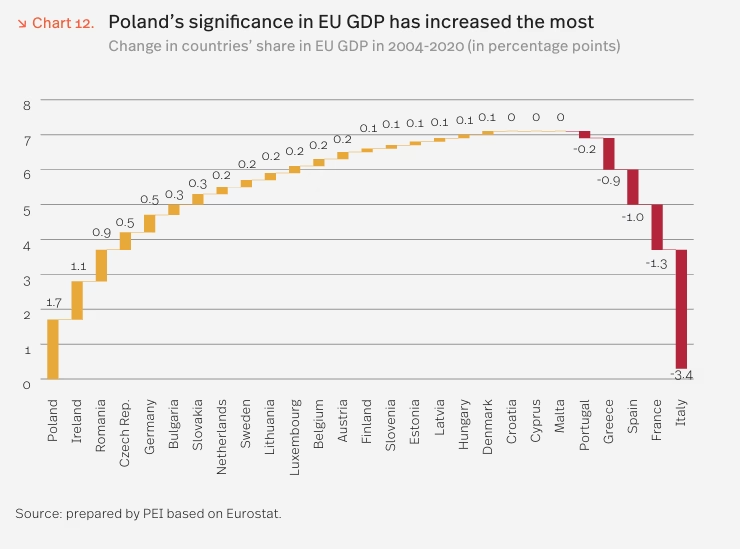
Despite this, Southern Europe still surpasses Central Europe in terms of total GDP, population, and investment in machinery and industrial equipment. In the latter category, Southern Europe’s share remains 2 percentage points higher than that of Central Europe. This means that despite Central Europe’s strong growth, production capital is accumulating faster in Southern Europe.
It should also be noted that Central Europe is highly heterogeneous. A key position is held by Germany, which accounts for 32% of value added in EU manufacturing. The Visegrad Group countries account for only 9% of value added in manufacturing and 7% of EU GDP.
The pandemic increased inequalities within global powers
The COVID-19 pandemic has increased inequalities within major economies. In the EU, its economic effects were most severe in the already declining Southern Europe. This is also illustrated by the coefficient of variation, which measures average deviation from the mean. The coefficient for GDP per capita in the EU rose from 42% to 46%.
In 2020, Poland also turned out to be the largest trade beneficiary of the pandemic—it not only achieved a record trade surplus but also increased its share in global trade the most among EU Member States (by 0.14 percentage points).
In the United States, the pandemic also deepened disparities and relatively strengthened the most economically powerful states, such as California and Texas. A similar pattern was observed in China, where in 2020 the most developed eastern provinces became even stronger compared to other regions.
***
The Polish Economic Institute is a public economic think tank with a history dating back to 1928. Its main research areas include foreign trade, macroeconomics, energy, and the digital economy, as well as strategic analyses of key areas of social and public life in Poland. The Institute prepares analyses and expert studies supporting the implementation of the Strategy for Responsible Development and promotes Polish research in economic and social sciences domestically and internationally.
Media contact:
Ewa Balicka-Sawiak
Press Officer
T: +48 727 427 918
E: ewa.balicka@pie.net.pl
