
Universal Basic Income A new idea for the welfare state?
Press release
Published: 08/06/2021
According to a study conducted by the Polish Economic Institute (PIE), 87% of Poles are unfamiliar with the details of the concept of Universal Basic Income (UBI). After becoming acquainted with the idea, however, the majority support its introduction, provided that it does not involve higher taxes, increased public debt, or cuts to existing social benefits. The proposal is particularly popular among young people with below-secondary education who do not have a stable source of income. At the same time, a clear majority of citizens (73%) declare that they would not give up work if they received such a benefit. These are the main conclusions of the PIE report “Universal Basic Income. A New Idea for the Welfare State?”
Universal Basic Income (also referred to as guaranteed or citizen’s income) is an instrument of fiscal policy under which every citizen, regardless of income level, would receive a regular cash payment from the state. Its purpose would be to ensure that everyone’s basic needs are met. Although no country currently implements UBI nationwide (Finland conducted a pilot programme in 2017–2018), the concept is increasingly discussed in the context of the challenges facing modern welfare states.
New social challenges
Guaranteed income could respond to the changing needs of contemporary societies. This is due, among other factors, to unequal access to social benefits for people in flexible forms of employment, as well as declining demand for certain professional skills. A benefit paid to every individual without any eligibility conditions could therefore address potential gaps in the current system of social security and assistance.
How could Universal Basic Income be financed?
The cost of financing Universal Basic Income—assuming monthly benefits of PLN 1,200 for people of working age and PLN 600 for children—would amount to PLN 376 billion annually. Funding such a programme would require higher taxes, increased public debt, or the abandonment of a significant share of existing social expenditures.
For comparison, in 2018 the total cost of the state’s social security and social assistance system amounted to PLN 343 billion, of which PLN 114 billion was allocated to various social assistance instruments. The remaining PLN 229 billion covered pensions and disability benefits.
What do Poles think about Universal Basic Income?
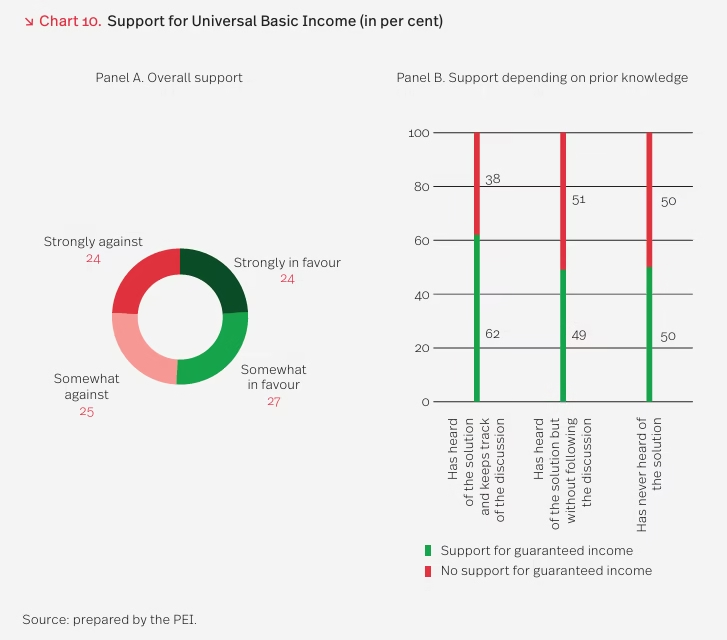
Knowledge of Universal Basic Income among Poles is relatively limited. 57% openly declare that they have never heard of such a solution. 30% claim they have encountered the term but do not know the details and are not interested in the topic. More detailed analyses indicate that both groups in fact had no prior knowledge of UBI. Only 13% of adult Poles declared that they are familiar with the idea of citizen’s income and follow the ongoing debate.
Overall, 51% of Poles aged 18–64 support the introduction of Universal Basic Income in principle. The PIE study also shows that support is highest among those who know the most about the concept—within this group, support rises to 60%. The proposal is also favored by a clear majority of people without a permanent source of income (those managing households or unemployed – 75%), those with only primary education (70%), and individuals aged 18–25.
Support declines significantly once potential funding sources are taken into account. Only 30% of respondents would support UBI if it required higher taxes. 28% would accept it if it meant a reduction in social services and benefits, while only 24% would support the scheme if it required increased public debt.
The study also shows that having a stable income reduces support for Universal Basic Income. Only 48% of employed individuals and 44% of retirees support a guaranteed benefit from the state. At the same time, 73% of working Poles declared that they would continue working if they received guaranteed income, while only 22% believe that other working people would behave in the same way.
“Our study revealed a significant discrepancy between how we assess our own diligence and responsibility and how we perceive others. We believe that we would continue working despite receiving a guaranteed benefit from the state, but only one in five of us believes that the same attitude would be adopted by a neighbor or coworker. The potential reduction in labor market activity among working individuals is one of the main arguments raised by opponents of Universal Basic Income. On the other hand, its supporters believe that removing all conditions for receiving such a benefit provides a sense of security and may encourage economically inactive individuals to take up work,” said Paula Kukołowicz, analyst in the Strategy Team at the Polish Economic Institute.
***
The Polish Economic Institute is a public economic think tank with a history dating back to 1928. Its main research areas include foreign trade, macroeconomics, energy, and the digital economy, as well as strategic analyses of key areas of social and public life in Poland. The Institute prepares analyses and expert studies supporting the implementation of the Strategy for Responsible Development and promotes Polish research in economic and social sciences domestically and internationally.
Media contact:
Ewa Balicka-Sawiak
Press Officer
T: +48 727 427 918
E: ewa.balicka@pie.net.pl
