
Economic Weekly 42/2026, October, 23, 2026
Published: 23/10/2026
Table of contents
Drought affects not only farmers but the entire economy
around 65% of municipalities experienced drought in spring cereal crops in 2026
nearly 0.2% of GDP is what drought could cost the Polish economy in an average year
This year’s drought is causing yet another season of losses for Polish farmers. According to the Institute of Soil Science and Plant Cultivation, between 21 March and 10 August this year, drought affected spring cereal crops in approximately 65% of municipalities and winter cereals in 57%. According to Statistics Poland’s preliminary estimates, this year’s cereal harvest will be around 5% lower than last year’s. However, droughts are not an exception in Poland; they are becoming a recurring cost of doing business. In a 2022 report, we estimated that farmers lose crops worth between PLN 3.9 billion and PLN 6.5 billion per year on average as a result of drought. This time, we examine the cost of drought for the entire economy, taking into account changes in prices, foreign trade and the reallocation of labour between sectors.
Our proprietary CGE-PL-PIE computable general equilibrium model captures the links between economic sectors, allowing us to trace how agricultural losses spill over into the rest of the economy. Using satellite data on water shortages in crops, we estimated crop losses for the years 2004-2025 and introduced them into the model as a shock. In an average year, drought reduces cereal and rapeseed yields by around 12%, and potato and sugar beet yields by approximately 20%. Compared with a counterfactual scenario in which no drought occurs, this results in GDP being nearly 0.2% lower per year, equivalent to approximately PLN 7.5 billion, based on Poland’s 2025 GDP [1].
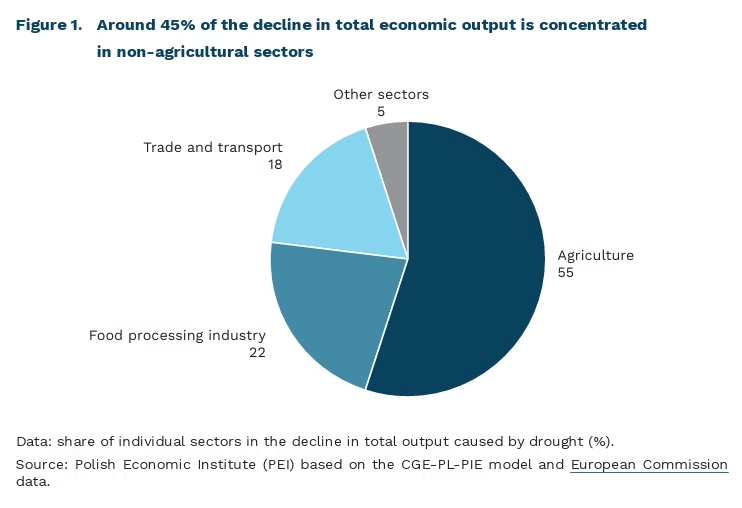
Almost all of the lost value added occurs in agriculture, but the decline in production affects the entire food supply chain. Around 45% of the decline in total production caused by drought occurs in non-agricultural sectors. Half of this decline is attributable to food processing, while the remainder affects sectors such as trade and transport. In these sectors, drought primarily reduces the scale of production rather than profit margins. Since purchased inputs account for a large share of their output value, their contribution to GDP declines only slightly. Similar findings have been reported for other EU economies, including Italy.
The recurring nature of droughts makes it necessary to move from responding to losses towards a systematic approach to drought risk management. The priority should be to increase landscape water retention by slowing water runoff. This means reducing excessive drainage, restoring rivers to more natural conditions, and protecting wetlands and forests. These measures should be complemented by monitoring and early-warning systems, as well as assessments of the vulnerability of individual areas to drought. Some of these measures could be financed through the Common Agricultural Policy. Reducing losses by one-fifth would lower the annual cost of drought by approximately PLN 1.5 billion.
- This estimate does not include drought-related losses in industry, the energy sector, inland waterway transport or forestry. The total cost of drought is therefore likely to be higher.
Jakub Kubiczek, Hubert Pliszka
The uptake of AI in businesses is finally gaining momentum
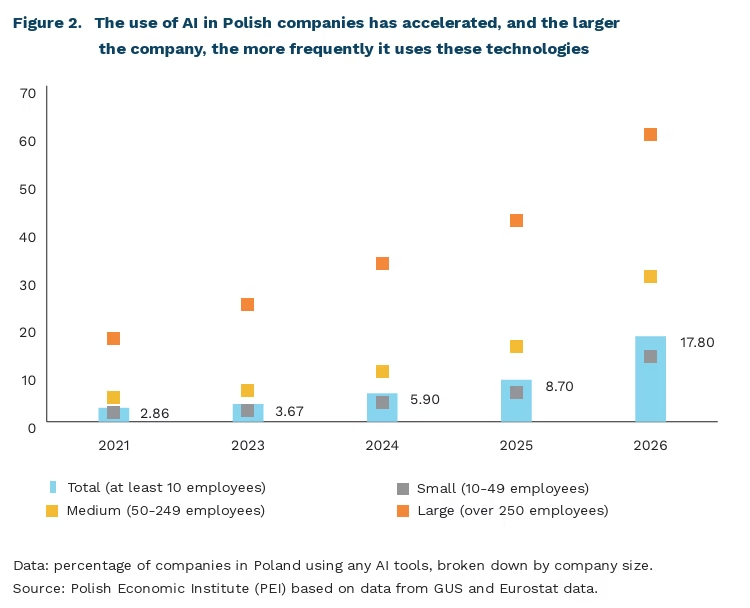
17.8% of businesses in Poland use AI technologies
59.9% of large businesses and 13.7% of small businesses use these technologies
17.8% of businesses in Poland were using artificial intelligence (AI) in the first half of 2026. The latest data from the Central Statistical Office (GUS) show an increase of 9.1 percentage points compared with 2025. As one might expect, and in line with previous data, larger companies are significantly more likely to use these technologies than medium-sized or small companies (59.8%, 30.3% and 13.7% respectively).
The results of the latest research show a significant acceleration in the rate at which companies are adopting AI. To some extent, this is a natural phenomenon, consistent with theories of innovation adoption. In the initial phase, the most innovative companies show the greatest interest in the technology; subsequently, once it has proven its value, its use spreads rapidly; finally, only the laggards remain – those most reluctant or with no need for new solutions – and the adoption rate reaches a state of saturation. It should be emphasised, however, that the data for Poland indicated a lag in the use of AI compared with other EU countries – a significant proportion of them had already moved beyond the initial implementation stage to the stage of widespread adoption.
A more than twofold increase in the proportion of companies using AI over the course of a year is significant and higher than has (historically) been the case in other EU countries. Eurostat data reveal 21 cases where the level of AI adoption by businesses in a given country ranged between 7% and 10% (and was therefore similar to the figure for Poland in 2025). However, in only one case was the year-on-year increase greater than 9.1 percentage points – in Lithuania in 2025. However this may be due to greater technological maturity and the availability of training and implementation programmes, rather than a qualitatively different approach on the part of the companies themselves.
The new data also covers the use of cloud computing – 58.6 of companies currently purchase such services, 3.9 percentage points more than in 2025. Cloud computing technology is now much more mature, so this modest growth was to be expected. Preliminary GUS data show that it is used primarily for email (41.5%), office software (35.8%) and file storage (36.4%). Here too, large firms use the cloud significantly more often than smaller ones (92.2% of large firms compared with 54% of small firms).
Data on the rise in the proportion of companies using AI are a positive sign of improvement in the level of digitalisation in Poland. As we have pointed out, this widespread adoption of AI in companies may yield the greatest economic benefits in the short term. However, simply adopting and implementing the technology is not enough. Deeper changes are needed in organisational structure, management methods and process organisation. This is evident, amongst other things, from World Bank research, the OECD studies we have described, and the conclusions from the analysis of skills shortages outlined in this issue of ‘Economic Weekly. As we look at the latest data coming in, it is therefore worth asking not ‘what is the scale of AI implementation’, but ‘how have we implemented AI’.
Ignacy Święcicki
EU leaders agree on a tougher line on China but remain divided over the budget
EUR 371.6 bn the EU’s trade deficit with China in 2025
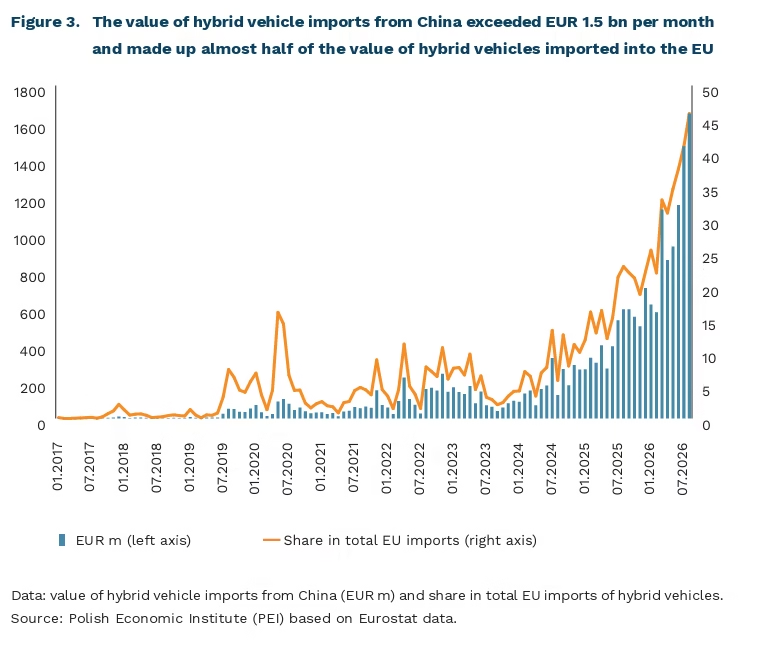
474 thousand hybrid vehicles worth EUR 8.4 bn imported by the EU from China between January and August 2026
350 thousand units: the planned cap on EU imports of hybrid vehicles from China in 2027
The October European Council did not reach agreement on the EU’s multiannual budget. For the frugal group of member states, informally led by Germany, the cuts in the Irish presidency’s budget proposal did not go far enough. The proposal cut funds managed centrally by the Commission, with the European Competitiveness Fund down 13% and Horizon Europe down 10%. The largest cuts fell on funding for defence and space technology projects and on the EU’s global action. The frugals want deeper cuts to reach other areas as well, such as agriculture and cohesion. Without a deal, it looks increasingly unlikely that negotiations will conclude by the end of 2026, before election campaigns begin in key member states (France, Spain, Poland and Italy). Leaders will therefore return to the budget talks at an extraordinary European Council in Dublin in November.,
The European Council did, however, confirm that member states are ready for a more assertive trade policy towards China. Leaders discussed “global macroeconomic imbalances” and called on the Commission to continue results-oriented dialogues, to make better use of existing EU instruments and to urgently prepare new tools to address these imbalances. In practice, this mainly concerns China and its international trade surpluses. The European Council also discussed extending import restrictions to further products and sectors, modelled on the safeguard measure for hybrid cars. These could include chemicals, industrial machinery and wind turbines. The Commission is analysing the scale of imports in these sectors through its import surge monitoring mechanism.
The agreement reached between Brussels and Beijing on 9 October 2026 is set to serve as the model solution. The agreement caps imports of Chinese hybrid cars at 350,000 units in 2027 and allows the cap to rise by 6% each year. This would be a significant change from the current situation: imports of these vehicles are expected to reach 800,000 units this year, and 350,000 units had already been reached by July. EU Trade Commissioner Maroš Šefčovič announced that the EU safeguard mechanism for hybrid cars, which provides for an import quota and tariffs on deliveries above the agreed cap, should be ready by December. The solution is meant to comply with World Trade Organization (WTO) rules. The Commission is also working on a diversification package aimed at reducing excessive import dependencies and encouraging companies to diversify their operations.
The restrictions adopted are a step in the right direction, but they will do little to curb the growth of the trade deficit with China, which exceeded EUR 371 bn in 2025. Sales of Chinese hybrid cars to the EU grew impressively, by 173% compared with the same period of 2025. Even so, they account for only 3% of the EU’s trade deficit with China and 2% of total imports in the first eight months of 2026.
Jan Strzelecki, Marek Wąsiński
Skilled workers are still needed, but they need new competencies
45.6% is the estimated share of people worldwide working in occupations requiring practical technical skills (maker skills)
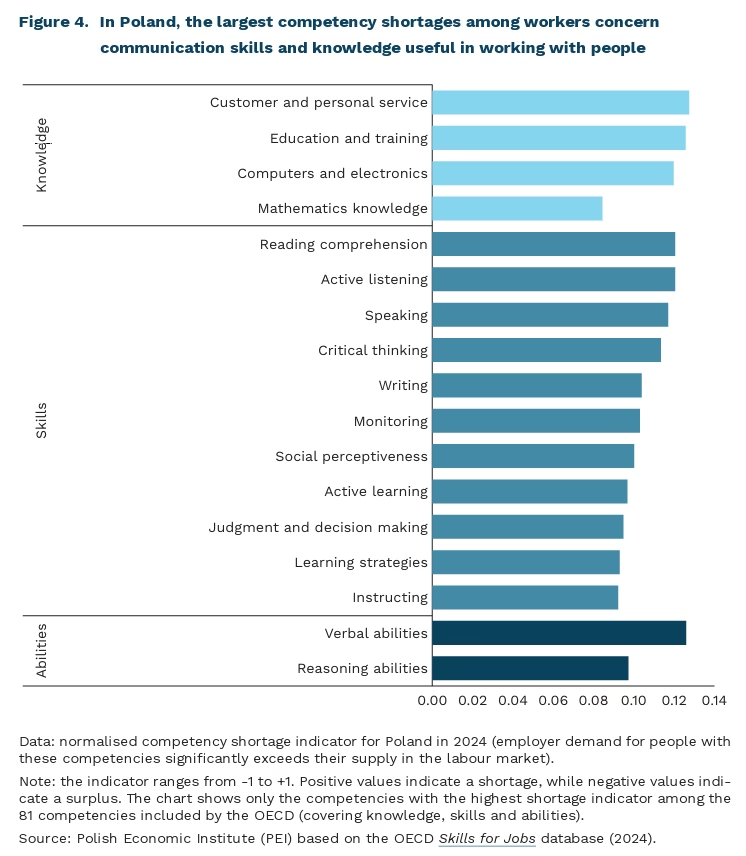
25 out of 81 knowledge, skill and ability areas examined by the OECD are characterised by a large shortage of workers who possess them in Poland (employer demand for people with these competencies significantly exceeds their supply in the labour market)
50% of European workers did not participate in training organised by their employer in the past 12 months
Occupations requiring practical technical competencies (maker skills [2]) account for 45.6% of global employment and form the foundation of industry, construction and transport. According to the World Economic Forum, the development of AI, energy and advanced manufacturing does not eliminate demand for workers performing jobs in the maker economy, but changes the requirements they face. Increasingly, they need to combine practical technical competencies with digital competencies and problem-solving, for example combining machine operation with the interpretation of production data, or mechanical knowledge with digital diagnostics. This does not mean replacing them with IT specialists, but rather that they need to expand their competencies into new areas.
Data on the Polish labour market show that workers face skill gaps relating both to knowledge and to the skills needed to apply it. The OECD Skills for Jobs database distinguishes three competency areas: knowledge (organised familiarity with facts and principles in a given field), skills (learned capacities needed to perform tasks) and abilities (relatively stable attributes that influence how work is performed). In Poland, a large shortage of workers exists, among others, in knowledge of computers and electronics, as well as in reading comprehension, active listening and critical thinking [3].
The shortage of workers with knowledge of computers and electronics is larger in Poland than the EU average. By contrast, the shortage of workers with mechanical knowledge [4] and production knowledge [5] is smaller. This does not automatically mean that Polish technical workers are better prepared. Rather, it shows that in Poland’s maker economy there is stronger pressure on digital competencies and weaker pressure on some traditional production competencies.
The problem in Poland’s maker economy is not so much the overall number of technical workers as the alignment of their competencies with employers’ needs. According to the OECD, there is a large shortage of ICT professionals and technicians, while the number of machine operators and stationary plant and machine operators matches current demand, and there is a surplus of metal processing workers and machine mechanics. Such broad categories may conceal local shortages and deficit specialisations, but they show that skills policy should combine increasing the supply of workers in shortage occupations with upskilling people already in work.
Closing qualification gaps requires training linked to the actual tasks performed at work. According to CEDEFOP, around half of workers in the EU did not participate in training organised by their employer in the past 12 months. Effective learning at work is supported not only by courses, but also by worker autonomy, manager support and opportunities to exchange knowledge with colleagues.
The development of maker skills should lead to practical skills used at work, rather than merely to further certificates of course completion. This can be supported by training based on real occupational tasks and by knowledge-sharing between workers, for example through reverse mentoring [6]. Micro-credentials, which are being piloted in Poland by the Educational Research Institute, may also be useful. These are digital records describing the specific skills acquired by a worker. As the OECD emphasises in its review of international micro-credential systems, their quality, transparency and links to labour market needs matter. For micro-credentials to be useful, they should describe the skills needed in specific occupations and be recognised by employers.
6. Reverse mentoring is a form of workplace learning in which a younger or less experienced worker shares knowledge and skills with an older worker or someone in a more senior position, for example on the use of new technologies. It reverses the traditional direction of mentoring, in which a more experienced worker supports the development of a less experienced one.
Cezary Przybył
Poles are more physically active than the average European
18.2% of Polish adults did not engage in any physical activity outside work during a typical week in 2025
26.4% of adults in EU countries did not engage in any physical activity outside work during a typical week in 2025
4.5% of Poles aged 16-24 did not engage in any physical activity during a typical week in 2025
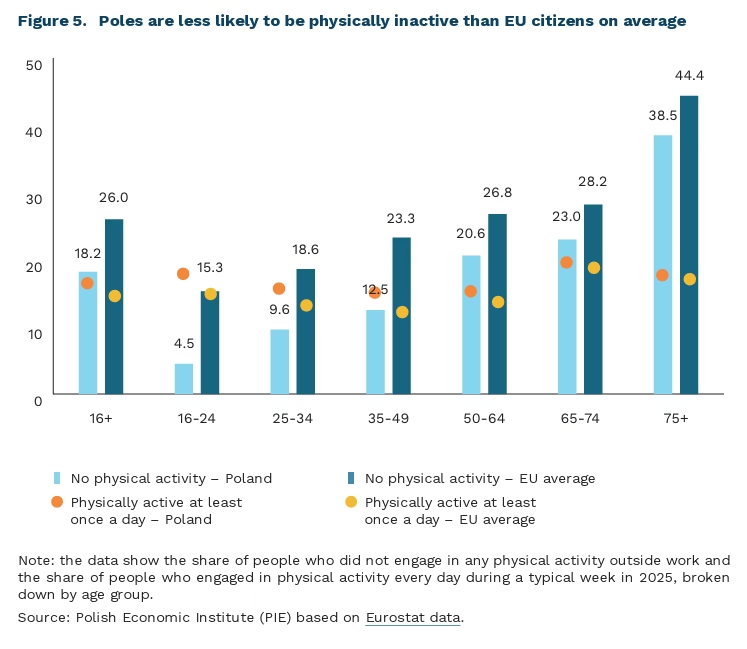
In 2025, 18.2% of Polish adults did not engage in any physical activity outside work. This was one of the lowest shares in the EU, with only six EU countries recording lower figures. Northern European countries performed best in this respect: Sweden, Finland and, outside the EU, Norway, with Denmark standing out in particular. In Denmark, just 2.8% of adults did not engage in any physical activity during a typical week. Moreover, the situation in Poland is improving. In 2022, the corresponding share was more than 6 percentage points higher.
A smaller proportion of the population could be described as highly physically active, although Poland also performs above the EU average in this category. In a typical week, 16.4% of Polish adults engaged in physical activity unrelated to work every day. The EU average for this category was 14.5%. Poland ranks slightly below the EU average in terms of the share of people who engage in physical activity several times a week, but not every day.
Young Poles are particularly physically active. In 2025, only 4.5% of people aged 16-24 did not engage in any physical activity during a typical week. This figure was almost 11 percentage points lower than the EU average. The share of physically inactive young Poles fell by more than half compared with 2022. Furthermore, in every age group surveyed, the share of people who did not engage in any physical activity outside work during a typical week was lower in Poland than the EU average.
Physical inactivity also varies by income, with the share of people who do not engage in any physical activity during a typical week declining across successive income quintiles. In the highest income quintile, 10.4% of Poles aged 16 and over did not engage in any physical activity. In the lowest income quintile, the figure was 24.9%. This gap is smaller than the EU average, where the difference is nearly 20 percentage points. However, differences in physical activity are not apparent among people who exercise daily: both in Poland and in the EU on average, the gap between the lowest and highest income quintiles is minimal.
Maintaining good health through regular exercise also has economic significance. Research conducted in various countries shows that physical activity helps people maintain their productivity and remain in the labour force by preventing conditions associated with physical inactivity. The World Health Organization estimates that physical inactivity will generate costs of around USD 300 billion over the 2020-2030 decade. Although Poles are less likely to be physically inactive than their EU counterparts, as we have previously noted, most Poles consider themselves to be in good physical condition. However, this assessment appears overly optimistic, given that many people engage in physical activity relatively infrequently. In Poland, public programmes and local initiatives should create opportunities for physical activity tailored to less active people and older age groups, while promoting physical activity throughout the life course to account for the ageing population.
Łukasz Baszczak
